Follow the journey through all 24 Sekki and discover how the people, plants, animals, and landscapes change throughout the year.
Map
A visual route through the village and its seasonal stories.
Stories
Seasonal excerpts rooted in weather, plants, animals, and village life.
Practice
Simple prompts for noticing the season where you are.
Explore Map
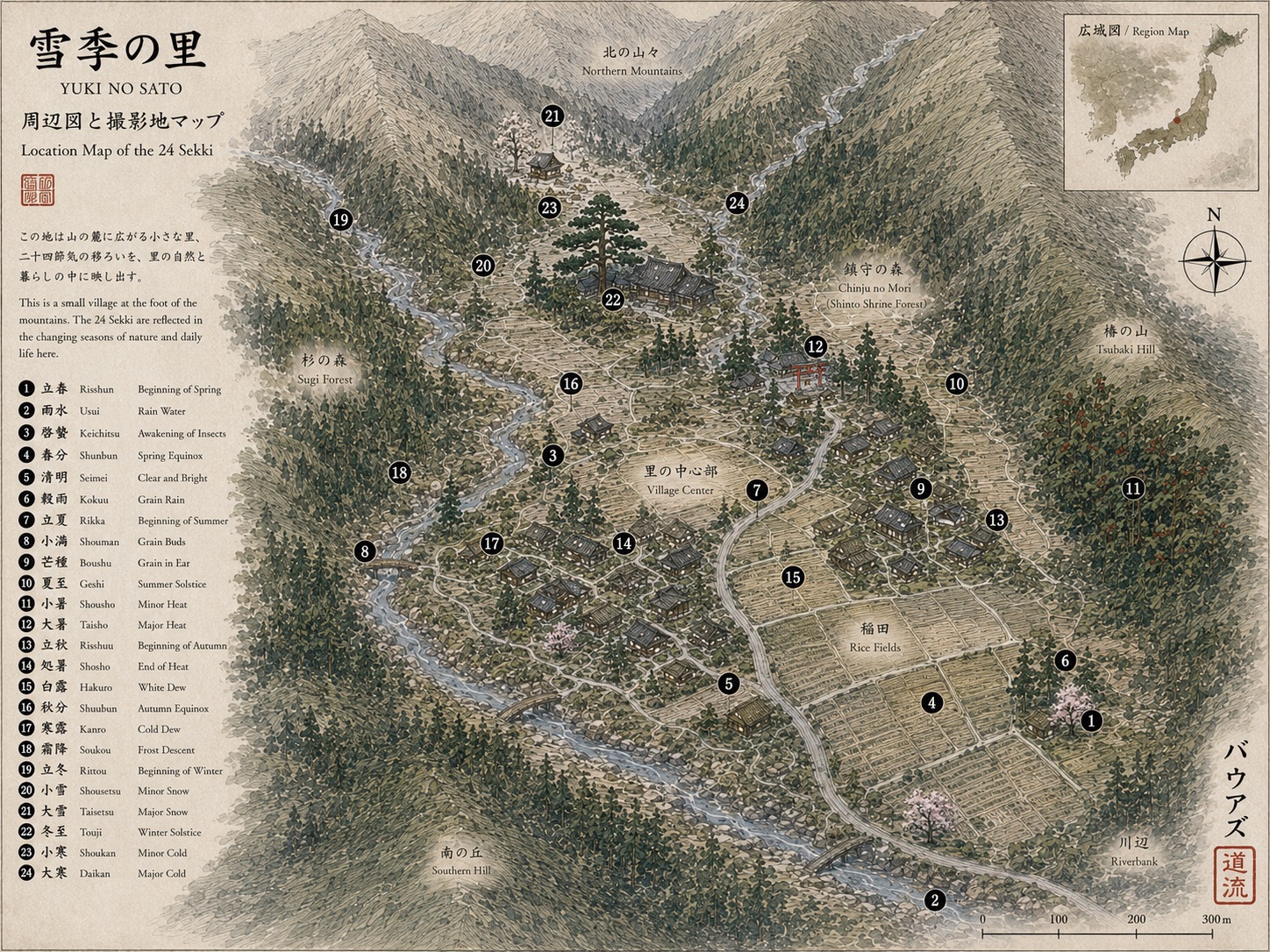
Yuki no Sato Sekki Village Map
Rotate to Portrait
The Sekki map is best viewed upright on mobile.
Ko Stories
Risshun – Beginning of Spring
Ko 1
East Wind Melts the Ice
The winter sun had not yet reached the bottom of the valley when Masaru-sensei stepped onto the river path.
Frost silvered the reeds and a thin sheet of ice still covered the slow water beneath the bridge. Most of the villagers spoke of winter as if it would last forever. The mountains certainly looked that way.
As Masaru-sensei approached Hana's cottage, he noticed something unexpected.
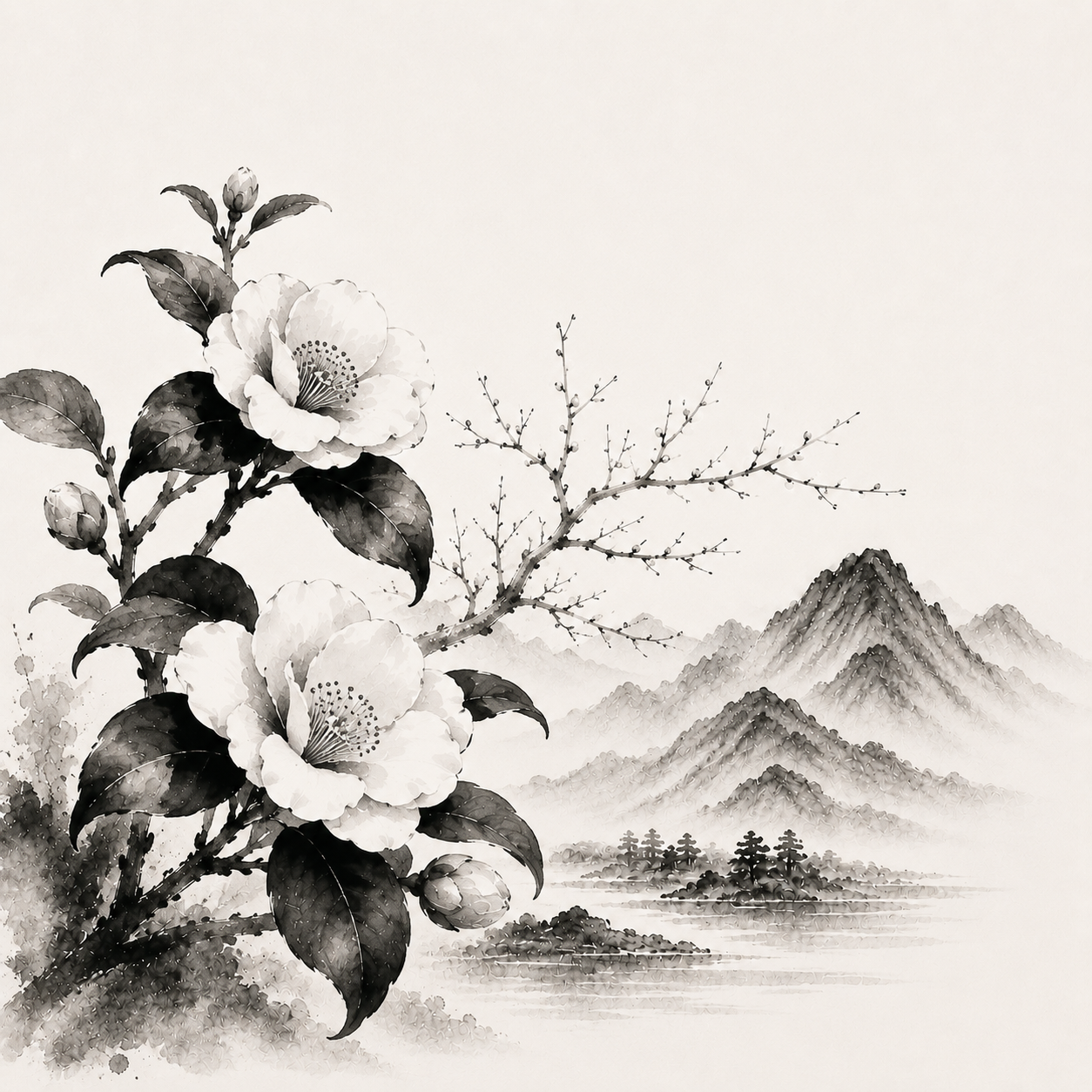
A single white camellia had opened beside her gate.
Hana was already outside sweeping snow from the path.
"There is still ice on the river," she laughed when she saw him studying the flower.
Masaru-sensei touched one of the petals.
"The season arrives before the weather."
The blossom seemed impossible. Everything around it remained asleep, yet the camellia had chosen this moment to bloom.
Hana watched him quietly.
"You always find spring before the rest of us."
Masaru-sensei smiled.
"The flower found it first."
He clipped a single branch and carried it home.
That evening he placed the camellia in a shallow suiban beside a weathered branch gathered from the riverbank. The bare branch carried the memory of winter. The camellia carried the promise of spring.
Together they revealed a truth that many people miss.
The seasons do not replace one another all at once.
For a short time they live together.
Outside, frost still covered the valley.
Inside, spring had already begun.
Character Spotlight
Hana is the oldest resident of Yuki no Sato. Widowed many years ago, she lives beside the river crossing and sweeps the path outside her home every morning regardless of season. The villagers believe she notices changes in people the same way Masaru-sensei notices changes in nature.
Ikebana Reflection
Materials
White Camellia, Bare River Branch
Theme
First Signs of Change
Lesson
Spring arrives before the weather.
Ko 2
Bush Warblers Begin to Sing
Several days after the first camellia opened, Masaru-sensei crossed the footbridge near the lower stream and heard shouting from the reeds.
"I heard it!"
Kenji emerged from the brush with wet boots and flushed cheeks.
"Heard what?" Masaru-sensei asked.
"The bush warbler."
The boy pointed toward a tangled thicket of alder and bamboo.
Masaru-sensei stood quietly.
For a moment there was only wind.
Then a delicate song drifted from somewhere deep within the branches.
Kenji immediately began searching.
He peered beneath every branch, pushed aside reeds, and climbed halfway up the riverbank.
"I can't find it."
The song came again.
Still invisible.
Masaru-sensei sat on a nearby stone.
"Do you know why people love the bush warbler?"
Kenji shook his head.
"Because it teaches patience."
The boy frowned.
"It won't come out."
Masaru-sensei smiled.
"It doesn't need to."
The song appeared again, floating over the water.
The bird remained hidden.
For the first time Kenji stopped searching.
The two listened together.
That afternoon Masaru-sensei returned to his studio.
Instead of using an open camellia flower, he selected a branch covered with tightly closed buds.
Beside it he placed a slender alder branch that extended beyond the edge of the arrangement.
Visitors asked why the flower had not opened.
Masaru-sensei pointed toward the buds.
"The season has already begun."
Just as the warbler had already arrived.
Some things become real before they become visible.
That evening Kenji returned to the riverbank.
The bird remained hidden.
This time he did not look for it.
He listened.
And somehow the song seemed closer.
Character Spotlight
Kenji is nine years old and notices birds, insects, clouds, and animal tracks long before most adults do. His curiosity often leads him into trouble, but it also allows him to witness the earliest signs of each season.
Ikebana Reflection
Materials
Camellia Buds, Alder Branch
Theme
The Unseen Becoming Known
Lesson
Presence does not require visibility.
Ko 3
Fish Rise Beneath the Ice
The cold returned after the warbler's song.
Snow dusted the northern hills, and the river once again wore a thin skin of ice.
Masaru-sensei found Jiro sitting beside the water near the old ferry landing.
The fisherman held a rod across his knees.
The line was not in the water.
"What are you watching?" Masaru-sensei asked.
Jiro pointed toward the center of the stream.
At first Masaru-sensei saw nothing.
The ice reflected the pale sky.
Then a shadow moved beneath the surface.
A second followed.
Fish.
Slowly circling beneath the frozen water.
"The river knows spring is coming," Jiro said.
"The mountains have not received the message."
Masaru-sensei laughed softly.
The two men sat together without speaking.
The fish continued moving beneath the ice.
Invisible one moment.
Visible the next.
The river appeared still.
Yet below the surface life had already begun changing.
A crow called from the far bank.
The fish disappeared.
Jiro nodded.
"They'll be back."
The old fisherman understood that certainty did not require proof.
That afternoon Masaru-sensei gathered a flowering camellia branch and a willow switch bent by winter storms.
The willow curved through the arrangement like a current beneath water.
The camellia stood above it.
Visible.
Obvious.
Easy to admire.
The willow guided the eye through empty space.
Like the fish beneath the ice.
When Jiro visited that evening, he studied the arrangement for several minutes.
Finally he smiled.
"The fish are there."
Masaru-sensei bowed.
Neither man felt the need to explain further.
Some truths are easier to see than to describe.
Character Spotlight
Jiro is the oldest fisherman in Yuki no Sato. He has spent his entire life along the river and can predict changes in weather by observing currents, birds, and the behavior of fish. Villagers often think he is resting when he sits beside the water. In truth, he is paying attention.
Ikebana Reflection
Materials
Camellia, Curved Willow Branch
Theme
Hidden Movement
Lesson
Much of life changes before we notice it.
Ko Stories
Usui – Rain Water
Ko 4
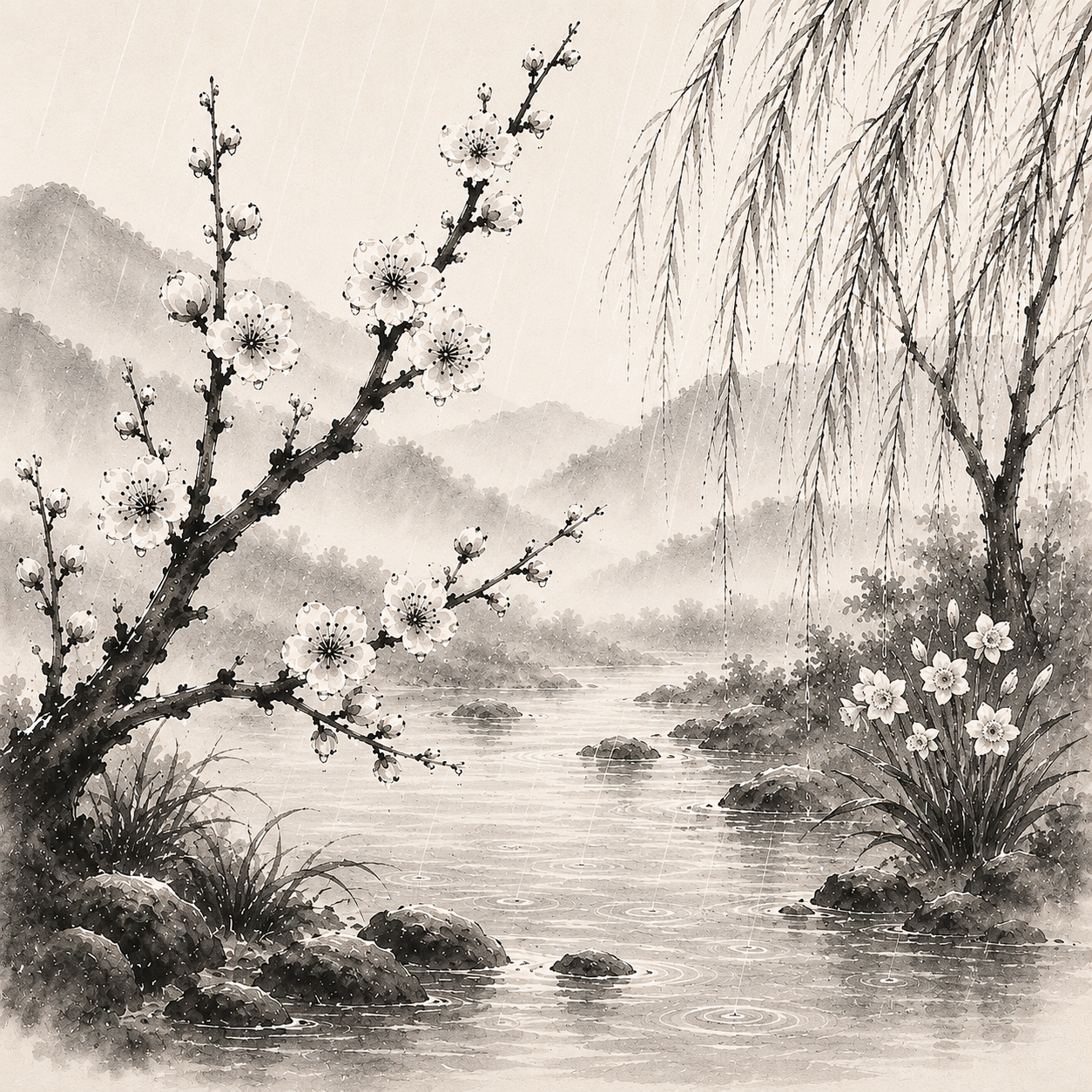
Rain Softens the Snow
The first warm rain arrived before dawn.
By morning, water dripped steadily from every roof in Yuki no Sato.
Snowbanks that had stood unchanged for weeks now slumped beside the road.
Masaru-sensei found Kenji standing on the bridge, launching small bark boats into the swollen stream.
Each boat rushed beneath the bridge and disappeared around the bend.
"You'll never see them again," Masaru-sensei said.
Kenji grinned.
"That's why I keep making more."
Together they watched the current carry the tiny boats away.
Along the riverbank, willow branches had begun to change.
Only days earlier they seemed stiff and lifeless.
Now they moved with the rain.
The branches bent but did not break.
Masaru-sensei clipped several slender willow stems.
Back in his studio he paired them with the final camellia blossom from Risshun.
The flower represented winter.
The willow represented movement.
The arrangement seemed to lean toward the future.
That evening the rain continued.
Kenji returned home soaked and happy.
As he crossed the bridge he noticed that every snowbank looked smaller than it had that morning.
Nothing dramatic had happened.
The rain had simply kept falling.
Character Spotlight
Kenji believes every stream leads somewhere important. His favorite place in the village is the bridge below the willow grove, where he launches boats and imagines distant journeys.
Ikebana Reflection
Materials
Willow, Remaining Camellia
Theme
Letting Go
Lesson
Change often begins with softening.
Ko 5
Mist Rises from the Earth
The valley disappeared overnight.
A pale mist settled across the fields and river until even familiar landmarks seemed distant.
Masaru-sensei walked slowly through the village.
The world felt smaller.
Near the communal washing area he found Mika hanging laundry despite the fog.
"You can barely see the river," Masaru-sensei said.
Mika laughed.
"I know where it is."
The answer stayed with him.
As the morning passed, villagers emerged from the mist one by one.
A farmer.
A child.
A merchant with a cart.
Each appeared briefly before vanishing again.
Nothing had changed.
Only visibility.
Along the edge of the path, willow branches softened the outline of the fog.
Drops of water clung to every stem.
Masaru-sensei gathered several branches and a patch of moss from a stone beside the stream.
His arrangement that afternoon was simple.
Low moss.
Graceful willow.
Large areas of empty space.
Visitors commented that it felt unfinished.
Masaru-sensei shook his head.
"It is complete."
The mist hides things.
It does not remove them.
Later, as the fog slowly lifted, sunlight revealed the mountains once more.
They had been there all along.
Character Spotlight
Mika is raising her daughter Rin while helping manage her family's household. She approaches life practically and rarely worries about things she cannot control.
Ikebana Reflection
Materials
Willow, Moss
Theme
Seeing Through Uncertainty
Lesson
Not every path needs to be fully visible.
Ko 6
Grass Begins to Sprout
The fields still looked brown.
To most villagers, winter remained.
But Daichi disagreed.
Masaru-sensei found him kneeling beside a terrace wall, studying the soil.
"What are you looking at?" Masaru-sensei asked.
Daichi pointed toward a patch of earth no larger than his hand.
A tiny green blade had emerged.
Masaru-sensei almost missed it.
"Only one?"
Daichi smiled.
"Today."
The farmer stood and looked across the valley.
"In a few weeks there will be thousands."
The blade was insignificant.
Yet it changed everything.
Because once one appeared, more would follow.
Masaru-sensei gathered a single grass shoot and several willow stems.
Back at his studio he created one of the smallest arrangements of the year.
Most visitors overlooked the grass entirely.
They admired the willow.
They noticed the container.
Only later did they discover the tiny green shoot.
When they did, the arrangement suddenly felt different.
The smallest element carried the greatest meaning.
That evening Daichi returned from the fields.
The grass remained no taller than before.
Still, he smiled when he saw it.
He knew what it would become.
Character Spotlight
Daichi farms rice terraces passed down through generations of his family. He trusts the soil, watches the weather closely, and rarely hurries anything that belongs to a season.
Ikebana Reflection
Materials
Willow, New Grass Shoot
Theme
Patience
Lesson
Growth is often invisible before it becomes obvious.
Ko Stories
Keichitsu – Awakening of Insects
Ko 7
Insects Stir Beneath the Soil
The stone wall separating Daichi's rice terraces had survived another winter, but several rocks had shifted with the frost. Masaru-sensei found the farmer kneeling in the morning sun, carefully resetting stones one at a time. As Daichi lifted a flat rock, he paused. "Look." Beneath the stone, tiny insects scattered through the dark soil. Some disappeared into cracks. Others remained still, as if uncertain whether winter had truly ended. Masaru-sensei knelt beside him. Only a few days earlier the ground had been frozen. Now life moved beneath every surface. The insects were not impressive. No bright wings. No beautiful colors. Yet their appearance changed the meaning of the entire season. Winter had lost its hold. The earth was awake. That afternoon Masaru-sensei carried home a small moss-covered stone and several blades of newly emerged grass. The arrangement was simple. Visitors focused on the stone. Few noticed the tiny grass. But Daichi smiled when he saw it. The grass was the reason the arrangement existed. The stone merely provided contrast. The smallest signs often carry the greatest meaning.
Character Spotlight
Daichi farms the oldest rice terraces in Yuki no Sato. He believes every season begins in the soil long before it appears in the fields.
Ikebana Reflection
Materials
Young Grass, Moss Covered Stone
Theme
Hidden Beginnings
Lesson
Life often begins before it is noticed.
Ko 8
Peach Buds Swell
Aki and Sora raced along the hillside path. Their mission was simple. Find spring. Not flowers. Not leaves. Spring itself. Aki searched the trees overhead. Sora searched the ground. Neither wanted to lose. Near the edge of an old orchard, Sora stopped. "I found it." Aki looked around. There were no flowers. No blossoms. Nothing remarkable. Sora pointed toward a peach branch. Tiny round buds lined every stem. "They aren't flowers." "Not yet," Sora replied. Masaru-sensei had been watching from farther down the path. He approached the tree and smiled. The younger sister had noticed something important. The buds carried more promise than certainty. The flowers existed. They simply had not arrived. That afternoon Masaru-sensei arranged a peach branch covered entirely in buds. Visitors seemed disappointed. "Why not wait until it blooms?" Masaru-sensei shook his head. "Because this is today's season." The arrangement celebrated what was becoming, not what had already become.
Character Spotlight
Aki and Sora are sisters who rarely agree on anything except that every season is worth exploring. Aki notices stories. Sora notices details.
Ikebana Reflection
Materials
Peach Branch, Budding Twigs
Theme
Potential
Lesson
Not all beauty has opened yet.
Ko 9
Caterpillars Appear
The children gathered around a shrub near the stream. Someone had discovered a leaf covered in holes. "Something ruined it." Everyone agreed. Everyone except Haru. The quiet boy studied the leaf carefully. "It isn't ruined." The others laughed. The leaf looked terrible. Half eaten. Uneven. Damaged. Then Haru pointed. Beneath the leaf sat a tiny caterpillar. The children fell silent. The damage suddenly became evidence. The leaf had not been ruined. It had been used. Masaru-sensei watched the conversation unfold. Later that day he selected several young leaves for an arrangement. One was perfect. The other carried small bite marks. When visitors questioned the damaged leaf, Masaru-sensei told them about the caterpillar. The arrangement changed immediately. What first appeared flawed became meaningful. The leaf told a larger story. One of growth. One of transformation. One of becoming. By evening the caterpillar had already moved to a new leaf. The old leaf remained behind. Its purpose fulfilled.
Character Spotlight
Haru is one of the quietest children in Yuki no Sato. While others search for large discoveries, Haru notices the small lives hidden beneath leaves, stones, and reeds.
Ikebana Reflection
Materials
Young Leaves, Weathered Branch
Theme
Transformation
Lesson
Imperfection often contains the next stage of beauty.
Ko Stories
Shunbun – Spring Equinox
Ko 10
Sparrows Begin Nesting
The cherry branch hanging above the river had begun to open. Not fully. Just enough. Masaru-sensei noticed it while crossing the bridge and saw another kind of activity nearby. Sparrows. One after another they darted through the air carrying bits of straw, grass, and twigs. Nearby, Emi stood watching. She had married only weeks before and recently moved into her husband's home on the eastern side of the village. "Busy creatures," she said. Masaru-sensei nodded. "They seem to know exactly what they're doing." Emi laughed softly. "I wish I felt the same." The sparrows flew in and out of a hole beneath the eaves of an old storehouse. Every trip looked insignificant. One blade of grass. One feather. One twig. Yet the nest grew. Masaru-sensei watched the birds for nearly an hour. That afternoon he arranged a flowering cherry branch with several strands of dried grass gathered from beneath the bridge. The arrangement looked incomplete. Almost fragile. Like a nest in its earliest stage. When Emi visited later she smiled. "It isn't finished." "No," Masaru-sensei said. "Neither is your new life." For the first time since her wedding, that uncertainty felt comforting.
Character Spotlight
Emi recently married into a family from the eastern side of the village. Though excited about her new life, she is still learning where she belongs. Like the sparrows, she is building a home one small piece at a time.
Ikebana Reflection
Materials
Cherry Branch, Dry Grass
Theme
Building Home
Lesson
Every home begins one piece at a time.
Ko 11
Cherry Blossoms Open
Three days later the village woke to discover the cherry trees had opened all at once. The path beside the river became crowded before breakfast. Children ran beneath the blossoms. Elders sat on benches. Merchants delayed opening their shops. Even Daichi left his fields for a few hours. Everyone had come for the same reason. The blossoms would not last. Masaru-sensei walked slowly beneath the trees. Petals drifted into the water and floated downstream. People pointed upward. Laughed. Shared food. Shared stories. Shared silence. The cherry trees belonged to no one. Yet everyone felt they belonged to them. That afternoon Masaru-sensei made the simplest arrangement of the year. A single flowering branch. Nothing more. The branch needed no help. The season was already complete. When visitors entered his studio they spent less time looking at the arrangement than they usually did. Instead they looked through the window toward the blossoms outside. Masaru-sensei considered that a success. Some arrangements point beyond themselves.
Character Spotlight
The people of Yuki no Sato spend much of the year working separately, but the cherry blossoms bring everyone together. For a few days each spring, the entire village becomes a single gathering.
Ikebana Reflection
Materials
Cherry Blossoms
Theme
Shared Joy
Lesson
Beauty grows when shared.
Ko 12
Distant Thunder Sounds
The blossoms were still beautiful. Perhaps even more beautiful than before. Yet Nobu knew they would soon be gone. The retired teacher sat beside the river listening to sounds most people ignored. When Masaru-sensei joined him, Nobu looked toward the mountains. "Thunder." Masaru-sensei listened. At first he heard nothing. Then, far beyond the valley, a low rumble. The storm remained invisible. For now. Around them the cherry trees continued shedding petals. Children played. Families gathered. The village celebrated. Yet change was already approaching. By evening clouds appeared above the western ridge. Wind moved through the branches. Petals filled the air. For a few minutes it seemed to snow pink and white. Masaru-sensei gathered several fallen blossoms and carried them home. Instead of arranging fresh flowers, he arranged petals. Visitors found the choice surprising. "Why not use the blossoms while they are still perfect?" Masaru-sensei looked toward the window. "Because this is today's season." The petals told a different story. Not about blooming. About passing. Nobu visited that evening. He studied the arrangement and smiled. "The storm is already here." Outside, thunder rolled once more across the mountains.
Character Spotlight
Nobu taught the village children for nearly forty years. Though retired, he still watches the seasons closely and often notices change before anyone else. He believes wisdom comes from paying attention to what is ending as much as what is beginning.
Ikebana Reflection
Materials
Cherry Branch, Fallen Petals
Theme
Impermanence
Lesson
Nothing remains at its peak forever.
Ko Stories
Seimei – Clear and Bright
Ko 13
Swallows Return
The first swallow arrived before sunrise. Masaru-sensei spotted it circling above the village square while opening the shutters of his studio. By midday there were six. By evening there were dozens. The birds moved through the air as if they had never left. Near the tea house Masaru-sensei encountered Ren, the traveling scholar. A canvas satchel hung over his shoulder, covered with notes and maps gathered from distant villages. "You've returned." Ren smiled. "So have they." Above them a swallow swept beneath the eaves before disappearing into an old nest. The scholar watched it carefully. "I've crossed mountains, rivers, and cities this year." "And what did you learn?" Ren considered the question. The swallow emerged again. "That every creature needs a place to return to." That afternoon Masaru-sensei gathered a fresh spring branch and several unfurling fern shoots. The arrangement reached upward while also curving inward. Movement and return. Departure and homecoming. When Ren visited that evening he stood quietly before the arrangement. "It feels familiar." Masaru-sensei nodded. "Exactly."
Character Spotlight
Ren is a scholar, mapmaker, and seasonal observer. He spends much of the year traveling but always returns to Yuki no Sato when spring arrives.
Ikebana Reflection
Materials
Fresh Spring Branch, Young Fern
Theme
Returning
Lesson
Sometimes we must leave to understand where we belong.
Ko 14
Wild Geese Fly North
The sky was unusually clear. Masaru-sensei and Taku stood beside the river watching a line of geese disappear toward the northern mountains. Neither spoke for several minutes. The birds moved steadily. Certain of their direction. Taku finally broke the silence. "When I was young, I thought leaving was the difficult part." Masaru-sensei glanced toward him. "And now?" The old man smiled. "Now I think staying is harder." The geese grew smaller. Soon they were only dark marks against the sky. Then they vanished. The river continued flowing. The mountains remained. Only the birds were gone. That afternoon Masaru-sensei arranged several willow branches in a tall container. Most of the composition consisted of empty space. Visitors asked whether something was missing. Masaru-sensei answered carefully. "No." The emptiness was the point. The geese had left. The sky remained. Departure creates space. Sometimes that space becomes its own kind of beauty.
Character Spotlight
Taku is one of the oldest villagers. Having watched generations come and go, he understands that every arrival eventually becomes a departure.
Ikebana Reflection
Materials
Willow, Empty Space
Theme
Farewell
Lesson
Gratitude is the proper companion to departure.
Ko 15
First Rainbows Appear
The rain ended as suddenly as it had begun. Sunlight poured into the valley. Children emerged from houses as if released from captivity. Aki was first. "Come quickly!" She ran so fast that Masaru-sensei nearly lost sight of her. At the edge of the rice terraces she stopped and pointed. A rainbow stretched across the entire valley. Bright. Temporary. Impossible to ignore. Aki stared upward. "Where does it end?" Masaru-sensei smiled. "Would it matter if you knew?" The girl thought about this. "No." They remained there for a long time. Villagers continued their work. Farmers returned to their fields. Merchants reopened their shops. Yet for a few minutes everyone looked up. The rainbow belonged to no one. Yet everyone shared it. Later that day Masaru-sensei arranged wildflowers gathered from several different places around the village. No single flower dominated. Together they created something larger than themselves. Like the colors of the rainbow. Like the village. Like the season. As evening approached, the rainbow disappeared. Aki looked disappointed. Masaru-sensei handed her a single flower. "Some things are beautiful because they stay." He pointed toward the empty sky. "And some things are beautiful because they don't."
Character Spotlight
Aki collects stories the way other children collect stones. She believes every season hides a secret and every path leads somewhere worth discovering.
Ikebana Reflection
Materials
Spring Wildflowers, Curving Branch
Theme
Wonder
Lesson
Not everything needs an explanation to have meaning.
Ko Stories
Kokuu – Grain Rain
Ko 16
Reeds Begin to Grow
Spring rain had fallen for three straight days. The paddies reflected the gray sky like polished mirrors. Masaru-sensei found Yuna standing ankle-deep in water near the terraces. Most people looked at the fields and saw mud. Yuna saw a future harvest. The first reeds had begun appearing along the irrigation channels. Their green shoots seemed insignificant against the broad landscape. Yuna knelt and touched one gently. "These are always first." "The rice?" She shook her head. "The reeds." Masaru-sensei looked surprised. "Then why do you care so much about them?" Yuna smiled. "Because they tell me the water is ready." The answer stayed with him. That afternoon he gathered a young reed and a peony bud from Chiyo's garden. The reed was simple. The peony promised abundance. Together they spoke of preparation. Most visitors admired the peony. Few noticed the reed. Yet without water, neither would survive. Yuna understood that. The season understood that. Growth often depends on things people overlook.
Character Spotlight
Yuna farms rice fields inherited from her family. She watches water levels, soil conditions, and seasonal signs with remarkable attention. To her, farming is less about crops and more about timing.
Ikebana Reflection
Materials
Peony, Young Reed
Theme
Preparation
Lesson
Growth begins long before harvest.
Ko 17
Frost Ends, Seedlings Grow
The village gathered in the paddies before sunrise. Bundles of young rice seedlings waited beside the flooded terraces. The planting season had begun. Masaru-sensei joined Yuna and several other farmers as they worked their way across the field. Each seedling looked fragile. Almost too fragile. The water rippled around their legs. The mountains reflected in the flooded terraces. Hours passed. Rows slowly appeared. "What if some don't survive?" Masaru-sensei asked. Yuna laughed. "Some won't." The answer surprised him. "You plant them anyway." "Of course." The farmer pushed another seedling into the mud. "If we waited for certainty, nothing would ever grow." That afternoon Masaru-sensei arranged a peony bloom with several young rice seedlings. The flower dominated the composition. The seedlings looked small and vulnerable. Yet everyone who visited understood which element represented the future. The peony would fade. The rice would feed the village. Trust often looks fragile at first.
Character Spotlight
Yuna believes every season requires courage. Farmers make decisions months before they know whether they were correct, yet they continue planting year after year.
Ikebana Reflection
Materials
Peony, Rice Seedlings
Theme
Trust
Lesson
Some work requires faith before results appear.
Ko 18
Peonies Bloom
By the end of Grain Rain, Chiyo's garden had transformed. The peonies opened almost overnight. Large blossoms leaned over stone paths and crowded the edges of the garden. Visitors arrived from neighboring villages to admire them. Masaru-sensei found Chiyo trimming healthy flowers. "You are cutting the best ones." "I know." The answer seemed strange. "Why?" Chiyo handed him the blossom. "If I keep every flower, none of them will be at their best." The gardener continued pruning. The garden looked less full afterward. Yet somehow more beautiful. Masaru-sensei carried the flower home. That evening he arranged a single peony with a simple spring branch. Nothing else. The blossom required no competition. Its beauty filled the room. Visitors asked why he had not used more flowers. Masaru-sensei remembered Chiyo's garden. Sometimes abundance is not about quantity. Sometimes abundance is knowing what to leave out.
Character Spotlight
Chiyo is Yuna's aunt and the village's most respected peony grower. She teaches that cultivation is not only about helping things grow but also knowing what to remove.
Ikebana Reflection
Materials
Peony, Spring Branch
Theme
Abundance
Lesson
Beauty requires discipline.
Ko Stories
Rikka – Beginning of Summer
Ko 19
Frogs Begin to Sing
The marsh beside the river had become impossible to ignore. Every evening it seemed louder. The frogs had returned. Masaru-sensei followed the sound one warm evening and found Haru sitting perfectly still on a flat stone near the water's edge. Most children ran through the marsh. Haru listened to it. The chorus rose and fell like waves. One frog called. Another answered. Soon dozens joined together. The marsh had become an orchestra. "What are they saying?" Haru asked. Masaru-sensei smiled. "They are announcing summer." The boy considered this. "They're very loud." "Perhaps they have been waiting all winter." The answer seemed to satisfy him. Along the edge of the water, the first water irises had begun to bloom. Their leaves rose confidently from the marsh. Unlike the tentative flowers of spring, these seemed certain of their place. That afternoon Masaru-sensei arranged iris and marsh grass in a shallow suiban. The arrangement felt upright and confident. Like a frog calling across the water. Like summer itself.
Character Spotlight
Haru rarely speaks unless he has something important to say. He notices sounds, insects, and patterns that most people overlook.
Ikebana Reflection
Materials
Water Iris, Marsh Grass
Theme
Finding Your Voice
Lesson
Every creature speaks in its own season.
Ko 20
Worms Surface
A night of steady rain left the village paths damp and fragrant. Masaru-sensei found Osamu working in the iris garden before sunrise. The gardener carried a basket and moved slowly between the planting beds. "What are you looking for?" Masaru-sensei asked. Osamu pointed toward the soil. Worms. Dozens of them had emerged after the rain. Most people stepped around them without a second thought. Osamu knelt beside one. "The flowers would not exist without them." Masaru-sensei watched quietly. The worms loosened the soil. They carried nutrients downward. They worked without recognition. Without praise. Without flowers of their own. Yet every iris depended on them. That afternoon Masaru-sensei selected the strongest iris bloom from Osamu's garden. Beside it he placed several fresh fern fronds. The iris received all the attention. The ferns quietly supported the composition. Just as the worms quietly supported the garden. Visitors admired the flower. Osamu admired the ferns. Masaru-sensei understood why.
Character Spotlight
Osamu maintains the village iris gardens. He believes the most important work is often the work no one notices.
Ikebana Reflection
Materials
Water Iris, Fresh Fern
Theme
Hidden Labor
Lesson
Much of what sustains beauty remains unseen.
Ko 21
Bamboo Shoots Appear
Kiku arrived at Masaru-sensei's door carrying a basket. Inside were bamboo shoots gathered from the grove before sunrise. "They weren't there last week," she said. Masaru-sensei laughed. "Perhaps you weren't looking." The cook shook her head. "No. They simply grew." Together they walked to the bamboo grove. Fresh shoots pushed through the forest floor in every direction. Some stood only a few inches high. Others already reached Masaru-sensei's knee. The speed seemed impossible. Spring had unfolded slowly. Summer arrived with confidence. Kiku harvested several shoots for the evening meal. The grove smelled fresh and alive. Everywhere they looked, growth pressed upward. That afternoon Masaru-sensei paired a young bamboo shoot with water iris. The arrangement emphasized vertical movement. Everything reached toward the sky. Everything seemed eager. When Kiku visited later, she laughed. "It looks like it's still growing." Masaru-sensei nodded. "That is exactly what I hoped."
Character Spotlight
Kiku is the village cook and one of the first people to notice seasonal ingredients. She measures the year not by dates, but by what appears in the market basket.
Ikebana Reflection
Materials
Water Iris, Bamboo Shoot
Theme
Potential Realized
Lesson
Growth can be astonishing when conditions are right.
Ko Stories
Shoman – Lesser Fullness
Ko 22
Silkworms Feed on Mulberry
The room above Aya's workshop sounded like rain. Not heavy rain. Soft rain. Thousands of tiny mouths feeding on mulberry leaves. Masaru-sensei sat beside the elderly woman while she spread fresh leaves across woven trays. The silkworms immediately began eating. "They never seem to stop," he said. Aya smiled. "Neither does the season." The worms looked insignificant. White. Slow. Fragile. Yet Aya knew what they would become. Silk. Cloth. Kimonos. Wedding garments. Festival banners. An entire future hidden within creatures no larger than a finger. Masaru-sensei watched the worms for a long time. Nothing dramatic happened. No sudden change. Only steady work. Leaf by leaf. Hour by hour. That afternoon he arranged young grain with a branch of mulberry. The grain represented visible growth. The mulberry represented nourishment. Visitors admired the grain. Aya admired the leaves. She understood that growth always depends on what feeds it.
Character Spotlight
Aya raises silkworms and has done so for most of her life. She believes patience is the most important skill a person can cultivate.
Ikebana Reflection
Materials
Young Grain, Mulberry Branch
Theme
Quiet Growth
Lesson
Great transformations are often fed one small bite at a time.
Ko 23
Safflower Blooms
Nami's hands were stained again. Yellow. Orange. Red. The colors shifted depending on the light. Masaru-sensei watched her sorting baskets of safflower blossoms beside the stream. The flowers themselves seemed modest. Few villagers paid them much attention. Yet Nami transformed them into color. She dipped cloth into steaming vats while explaining each step. "The flower isn't the color." Masaru-sensei looked confused. "It becomes the color." The distinction mattered. Potential and realization. Possibility and expression. The same lesson appeared throughout the village during Shōman. The grain was filling. The fields looked richer every day. The future harvest could already be imagined. That afternoon Masaru-sensei arranged safflower with young grain. The composition celebrated things not yet fully revealed. Visitors saw flowers. Nami saw dye. Farmers saw grain. Masaru-sensei saw the season itself. Everything was becoming more than it had been.
Character Spotlight
Nami dyes cloth using plants gathered throughout the year. She sees possibilities in ordinary things long before others recognize them.
Ikebana Reflection
Materials
Young Grain, Safflower
Theme
Hidden Color
Lesson
Some gifts remain invisible until the right moment.
Ko 24
Wheat Begins to Ripen
Yori walked the fields every morning. Not because the grain changed quickly. Because it changed slowly. The young farmer stopped beside a stand of wheat and rubbed a head of grain between his fingers. "Not yet." Masaru-sensei had heard him say the same thing yesterday. And the day before. And the day before that. "How do you know?" Yori held out the grain. "It feels different." Masaru-sensei examined it. The difference seemed tiny. Yet Yori could feel it immediately. The wheat was filling. Ripening. Preparing. But not ready. The distinction mattered. Many people confuse fullness with completion. The season did not. That afternoon Masaru-sensei arranged ripening grain with simple field grasses. The grain bowed slightly under its own weight. Visitors admired its abundance. Yori noticed something else. The heads had not fully lowered. The harvest was near. Not here. Near. The arrangement captured the exact moment between promise and fulfillment.
Character Spotlight
Yori is one of the youngest farmers in Yuki no Sato. He is still learning the difference between acting quickly and acting at the right time.
Ikebana Reflection
Materials
Ripening Grain, Field Grass
Theme
Readiness
Lesson
Fullness is not the same as completion.
Ko Stories
Boshu – Grain in Ear
Ko 25
Mantis Hatch
The grain fields had grown so tall that children disappeared when they stepped between the rows.
Haru wandered carefully through the paths between the stalks.
He stopped suddenly and knelt.
A tiny mantis clung to a blade of grass.
Its body was no longer than a grain of rice.
Its front legs were folded as though in prayer.
Masaru-sensei crouched beside him.
"It looks fierce."
Haru nodded.
"It looks important."
The insect remained perfectly still.
Around it the grain swayed in the summer breeze.
Everything about the creature suggested confidence despite its size.
Masaru-sensei thought about that as they continued walking.
Many villagers admired the grain.
Few noticed the small lives hidden among it.
Yet the fields belonged to both.
That afternoon Masaru-sensei arranged heavy grain stems with a few strands of wild grass.
The arrangement seemed simple until one noticed a tiny curve hidden among the lines.
Visitors often missed it.
Haru never did.
Like the mantis, it rewarded attention.
Character Spotlight
Haru notices details most people miss. His ability to remain still allows him to discover a world hidden within the larger landscape.
Ikebana Reflection
Materials
Ripening Grain, Wild Grass
Theme
Hidden Strength
Lesson
Great strength often begins very small.
Ko 26
Fireflies Rise
The village gathered near the stream after sunset.
Word had spread.
The fireflies had arrived.
Children carried blankets.
Families brought tea.
Even Daichi left his fields early.
At first there was nothing.
Then one point of light appeared above the water.
Another followed.
Then dozens.
Soon the entire riverbank shimmered.
Mei stood beside Masaru-sensei watching silently.
As the village lantern maker, she spent most of the year creating light for others.
Tonight the insects had taken over her profession.
"They're better at it than I am."
Masaru-sensei laughed.
"Only because they work together."
The fireflies drifted among the reeds like floating stars.
The darkness had not changed.
Yet the entire landscape felt different.
That evening Masaru-sensei created a low arrangement of grain and stream grass.
Large spaces remained between the materials.
The empty spaces mattered.
Without darkness, the lights would not be visible.
Without silence, music would disappear.
Without space, beauty could not breathe.
Character Spotlight
Mei crafts lanterns for homes, festivals, and ceremonies. She understands that illumination is not about brightness but about helping people see.
Ikebana Reflection
Materials
Grain, Stream Grass
Theme
Light
Lesson
Even small lights can transform darkness.
Ko 27
Plums Turn Yellow
The scent reached Masaru-sensei before the orchard came into view.
Sweet.
Sharp.
Familiar.
Kiku stood beneath a plum tree with baskets arranged around her feet.
The fruit had begun turning yellow.
Soon it would be ready.
The cook moved quickly.
The season would not wait.
Plums would become pickles.
Syrups.
Preserves.
Meals for months yet to come.
Masaru-sensei watched her work.
"You spend summer preparing for winter."
Kiku smiled.
"Every season prepares for another."
The answer felt larger than food.
The grain in the fields was ripening.
The plums were changing color.
Everything seemed to be preparing.
Nothing stood still.
That afternoon Masaru-sensei arranged a fruiting plum branch beside heavy grain stems.
The grain bent beneath its own weight.
The fruit pulled downward from the branch.
Both suggested abundance.
Both suggested responsibility.
The village was entering the richest part of the year.
The work, however, had only begun.
Character Spotlight
Kiku measures time through ingredients. She understands that abundance is fleeting and believes every harvest deserves gratitude and careful preparation.
Ikebana Reflection
Materials
Heavy Grain, Fruiting Plum Branch
Theme
Preservation
Lesson
The season must be honored before it passes.
Ko Stories
Geshi – Summer Solstice
Ko 28
Self-Heal Withers
The lotus pond was at its most beautiful.
Broad leaves covered the water and the first blossoms stood proudly above the surface.
Yet Sayo was not looking at the lotus.
She was gathering self-heal from a meadow beyond the pond.
The small purple flowers had begun to fade.
Masaru-sensei watched as she carefully cut stems and tied them into bundles.
"Why collect them now?"
"Because they are disappearing."
The answer surprised him.
Most people gathered flowers when they were at their best.
Sayo shook her head.
"By the time people notice something fading, they are often too late."
The herbalist spread the plants beneath a covered porch where they would dry in the summer air.
The flowers looked less impressive than they had only days before.
Yet their usefulness remained.
Perhaps it had even increased.
That afternoon Masaru-sensei arranged a broad lotus leaf with several stems of drying self-heal.
The lotus represented midsummer abundance.
The herb represented impermanence.
Visitors admired the lotus first.
Sayo admired the herb.
Masaru-sensei appreciated both.
The season contained them equally.
Character Spotlight
Sayo gathers medicinal plants throughout the year. She pays particular attention to moments of transition, believing they reveal the true nature of a season.
Ikebana Reflection
Materials
Lotus Leaf, Drying Herb
Theme
Letting Go
Lesson
Every season contains both growth and decline.
Ko 29
Lotus Opens
The pond appeared calm from a distance.
Only when one stood at its edge could they see what lay beneath.
Mud.
Roots.
Decaying leaves.
Jiro sat on a weathered dock watching dragonflies skim across the surface.
The fisherman pointed toward a newly opened lotus blossom.
"People admire the flower."
Masaru-sensei nodded.
"They rarely admire the mud."
The two men laughed.
The lotus rose from the darkest part of the pond.
Yet its blossom remained untouched by the water below.
For years Jiro had watched the same cycle repeat itself.
The pond never changed.
The lesson never changed.
That afternoon Masaru-sensei arranged a single lotus blossom and one broad leaf.
Nothing else.
The arrangement needed no additional material.
The flower carried enough meaning by itself.
When visitors entered the studio they immediately noticed the blossom.
Only later did they ask where it had come from.
"The pond," Masaru-sensei answered.
Most of them imagined the flower.
Few imagined the mud.
Character Spotlight
Jiro has spent his life beside rivers and ponds. He understands that what lies beneath the surface often determines what appears above it.
Ikebana Reflection
Materials
Lotus Blossom, Lotus Leaf
Theme
Rising Above
Lesson
Beauty can emerge from difficult places.
Ko 30
Crow-Dipper Grass Dries
Kenji carried a handful of dried grass into Masaru-sensei's studio.
The stems looked unremarkable.
Brittle.
Pale.
Ordinary.
The boy dropped them onto the worktable.
"Why would anyone keep this?"
Masaru-sensei smiled.
"Why indeed?"
Together they walked to the river.
Along the shaded banks, fresh vegetation thrived.
But in one sunny stretch, the crow-dipper grass had already begun to dry.
Summer had arrived differently in different places.
Some plants were reaching their peak.
Others had already begun their decline.
The realization fascinated Kenji.
Until then he had imagined that seasons affected everything equally.
The river taught otherwise.
That afternoon Masaru-sensei arranged a broad lotus leaf beside several stems of dried grass.
The contrast was striking.
One represented abundance.
The other represented transience.
Neither was more important.
Without one, the other lost meaning.
Kenji stared at the arrangement.
For the first time he understood why Masaru-sensei sometimes chose damaged, faded, or drying material.
Every season contained opposites.
The arrangement simply revealed them.
Character Spotlight
Kenji's curiosity continues to deepen. He no longer asks only what something is, but why it matters.
Ikebana Reflection
Materials
Lotus Leaf, Dried River Grass
Theme
Contrast
Lesson
Understanding often comes from comparison.
Ko Stories
Shosho – Lesser Heat
Ko 31
Warm Winds Arrive
The wind arrived before the heat.
At dawn, the bamboo grove behind the village whispered with movement.
Masaru-sensei followed the sound and found Saburo already at work.
The bamboo craftsman sat beneath the grove splitting stalks into thin strips for basket weaving.
The wind moved through the leaves above them.
Not one stalk resisted.
Not one stood rigid.
Everything moved.
Everything returned.
Saburo paused his work.
"People think bamboo is strong because it stands tall."
He shook his head.
"It survives because it bends."
The lesson seemed simple.
Yet Masaru-sensei knew many people who had broken themselves trying to remain rigid.
The bamboo grove understood something they did not.
The wind would always come.
That afternoon Masaru-sensei arranged several bamboo stems with summer grasses gathered along the stream.
The composition leaned slightly.
Visitors assumed it had been placed incorrectly.
Saburo laughed when he heard this.
"The arrangement is listening to the wind."
Masaru-sensei liked that answer.
Character Spotlight
Saburo creates baskets, fences, fishing traps, and tools from bamboo. He believes nature solves problems more elegantly than people do.
Ikebana Reflection
Materials
Bamboo, Summer Grass
Theme
Adaptability
Lesson
Strength comes from learning when to bend.
Ko 32
Lotus Flowers Open
The temple pond reached its peak during Minor Heat.
Every morning new lotus blossoms opened across the water.
Sister Rei walked the pond's edge before sunrise, removing fallen leaves and clearing debris.
Masaru-sensei often joined her.
The work seemed endless.
Every day the pond changed.
Every day it needed attention.
One morning Masaru-sensei asked if she ever became tired of the routine.
Sister Rei smiled.
"The lotus opens only once."
She pointed toward a flower catching the first light.
"If I miss today, I miss today forever."
The answer stayed with him.
Most people waited for important moments.
Sister Rei paid attention to ordinary ones.
That afternoon Masaru-sensei arranged lotus with bamboo.
The lotus represented stillness.
The bamboo represented movement.
Together they created balance.
Visitors called the arrangement peaceful.
Masaru-sensei thought of Sister Rei waking before dawn.
Peace, he realized, required participation.
Character Spotlight
Sister Rei tends the temple grounds and seasonal gardens. She approaches each task with quiet attention and rarely speaks unless her words improve the silence.
Ikebana Reflection
Materials
Lotus, Bamboo
Theme
Presence
Lesson
Being fully present is its own form of wisdom.
Ko 33
Young Hawks Learn to Fly
Toma wanted to leave Yuki no Sato.
Everyone knew it.
The young man spent hours on the hills above the village staring toward distant mountain passes.
One afternoon he brought Masaru-sensei to a rocky overlook.
"Look."
A hawk perched on a pine branch high above the valley.
Nearby, two young birds shifted nervously.
The parent launched into the air.
The young hawks hesitated.
One remained on the branch.
The other jumped.
For a moment it seemed to fall.
Then its wings caught the wind.
The bird rose.
Toma watched silently.
Neither he nor Masaru-sensei spoke until the hawk disappeared beyond the ridge.
"It looked frightened."
Masaru-sensei nodded.
"So did you."
Toma laughed.
The observation was fair.
That evening Masaru-sensei arranged bamboo with a single feather found beneath the overlook.
The feather carried movement.
The bamboo carried support.
Without the branch, there could be no flight.
Without flight, the branch would become a prison.
Visitors often interpreted the arrangement differently.
Toma did not.
He understood it immediately.
Character Spotlight
Toma dreams of seeing the world beyond the valley. Though restless by nature, he is beginning to understand that departure requires preparation as well as desire.
Ikebana Reflection
Materials
Bamboo, Hawk Feather
Theme
Courage
Lesson
Growth eventually requires leaving the branch.
Ko Stories
Taisho – Greater Heat
Ko 34
Paulownia Seeds Ripen
The air felt heavy long before the storm arrived.
Even the birds seemed quieter.
Masaru-sensei found Ren beneath a paulownia tree near the edge of the village.
The scholar held one of the dried seed pods in his hand.
"It looks finished," Masaru-sensei said.
Ren shook his head.
"It is preparing."
He opened the pod carefully.
Inside were dozens of seeds.
The tree had spent all season gathering sunlight, water, and warmth.
Now it held a future forest inside a single shell.
Dark clouds gathered above the mountains.
The wind had not yet arrived.
The rain had not yet fallen.
Yet everything in the valley seemed to be waiting.
Masaru-sensei carried a seed pod home and paired it with a broad summer leaf.
The leaf represented the season's abundance.
The pod represented what came after.
Visitors admired the leaf.
Ren admired the seeds.
The difference made Masaru-sensei smile.
The future rarely draws attention until it arrives.
Character Spotlight
Ren sees patterns where others see isolated events. His travels have taught him that every ending contains the beginning of something else.
Ikebana Reflection
Materials
Broad Summer Leaf, Paulownia Seed Pod
Theme
Readiness
Lesson
Preparation is often invisible until the moment it is needed.
Ko 35
Earth Becomes Damp and Hot
The heat settled over Yuki no Sato like a blanket.
The air barely moved.
Even breathing felt like work.
By afternoon thunderheads towered above the western mountains.
Mika hurried through the village carrying groceries while her daughter Rin walked beside her.
The storm broke before they reached home.
Rain fell in sheets.
Wind rattled shutters.
The road disappeared beneath flowing water.
Masaru-sensei opened the door of his studio and waved them inside.
For an hour they sat together listening to thunder.
Rin counted the seconds between lightning and sound.
Mika laughed each time the child lost track.
Outside, the storm felt overwhelming.
Inside, tea steamed gently.
Conversation drifted.
The room felt calm.
Masaru-sensei realized that shelter is not merely a roof.
It is people.
After the storm passed, he arranged storm-bent grass with a sturdy summer branch.
The grass showed what had endured.
The branch showed what had protected.
Together they told the story of the afternoon.
Character Spotlight
Mika understands that families are built through ordinary acts of care repeated over time. During difficult moments she naturally becomes an anchor for those around her.
Ikebana Reflection
Materials
Storm Bent Grass, Summer Branch
Theme
Endurance
Lesson
Comfort is often created rather than found.
Ko 36
Great Rains Fall
The river escaped its banks during the night.
By morning several paths had disappeared beneath muddy water.
Villagers gathered with shovels and tools to clear debris.
Saburo was already working when Masaru-sensei arrived.
The bamboo craftsman stood knee-deep in water removing branches caught against a bridge.
The current pushed hard against him.
Yet he moved steadily.
Patiently.
Without complaint.
By midday the rain finally eased.
The damage looked worse than it was.
A washed-out path.
Broken fences.
Scattered branches.
The village would recover.
It always did.
Saburo picked up a reed flattened by the flood.
"It survived."
Masaru-sensei examined it.
The stem bent sharply but remained intact.
Much like the bamboo Saburo worked with every day.
That evening Masaru-sensei arranged the reed beside a bamboo stem.
The two materials seemed to lean toward one another.
Visitors described the arrangement as strong.
Saburo disagreed.
"It isn't strength."
"What is it?"
"Recovery."
Masaru-sensei thought about that for a long time.
The distinction mattered.
Character Spotlight
Saburo respects materials that survive difficult conditions. He often says that bamboo's greatest quality is not its strength, but its willingness to bend.
Ikebana Reflection
Materials
Flood Bent Reed, Bamboo
Theme
Resilience
Lesson
Strength is measured by recovery, not resistance.
Ko Stories
Risshu – Beginning of Autumn
Ko 37
Cool Winds Begin
The day remained hot.
The sun remained bright.
The cicadas still filled the valley with sound.
Yet Kenta insisted autumn had arrived.
Masaru-sensei found him on the hillside above the village watching the grasslands.
"Feel that?" Kenta asked.
Masaru-sensei felt nothing unusual.
The shepherd smiled.
"Wait."
A moment later a breeze crossed the hill.
The susuki grass bowed gently.
It was a small thing.
Almost nothing.
Yet somehow the entire landscape felt different afterward.
"The wind has changed."
Masaru-sensei looked across the valley.
The fields remained green.
The river remained full.
Summer appeared untouched.
But Kenta was right.
Something had shifted.
That afternoon Masaru-sensei arranged susuki grass with a weathered branch from the hillside.
The arrangement seemed to lean into empty space.
Like the grass.
Like the season.
Visitors often asked where autumn was.
Masaru-sensei pointed to the movement.
Not the material.
The movement.
That was where autumn lived.
Character Spotlight
Kenta spends most of his days on the hills above Yuki no Sato. He notices wind, clouds, and distant weather before anyone else in the village.
Ikebana Reflection
Materials
Susuki Grass, Hill Branch
Theme
Change
Lesson
The season often changes before the weather does.
Ko 38
Evening Cicadas Sing
The cicadas had filled the valley for weeks.
Most villagers barely noticed them anymore.
Taku noticed.
He noticed because there were fewer each evening.
Masaru-sensei joined the old man beside the river as the sun disappeared behind the mountains.
The cicadas sang.
Not loudly.
Not continuously.
The chorus felt thinner than before.
"The season is changing," Taku said.
Masaru-sensei listened carefully.
The old man was right.
The sound remained.
But something had been lost.
Or perhaps gained.
The silence between songs had become larger.
Near the riverbank they discovered an empty cicada shell clinging to a reed.
A small thing.
Easy to overlook.
Yet it told the entire story.
Growth.
Transformation.
Departure.
That evening Masaru-sensei arranged susuki with the empty shell.
The grass represented the coming season.
The shell represented the one departing.
Visitors often focused on the grass.
Taku focused on the shell.
He understood that endings deserve attention too.
Character Spotlight
Taku has lived through more seasons than anyone else in the village. He believes that paying attention to endings is one of the ways people learn gratitude.
Ikebana Reflection
Materials
Susuki, Cicada Shell
Theme
Passing Time
Lesson
Every voice eventually becomes an echo.
Ko 39
Thick Fog Descends
The fog arrived before dawn.
By sunrise the valley had vanished.
The mountains disappeared.
The river disappeared.
Even the road through the village seemed uncertain.
Masaru-sensei climbed the hillside looking for Kenta.
The shepherd was exactly where he expected him to be.
Standing quietly among the grass.
"You can barely see anything."
Kenta nodded.
"Yet I still know where I am."
The answer felt important.
The fog hid landmarks.
Not reality.
The hills remained.
The sheep remained.
The path remained.
Only visibility had changed.
The two men stood together listening to the muffled world around them.
Every sound felt closer.
Every step felt more deliberate.
That afternoon Masaru-sensei arranged susuki and river reed.
Large areas of empty space surrounded the materials.
The arrangement felt incomplete.
Intentionally so.
Visitors searched for what was missing.
Masaru-sensei smiled.
They were having the same experience as the valley.
The fog was not hiding the season.
It was part of it.
Character Spotlight
Kenta's life in the hills has taught him confidence in uncertain conditions. He trusts experience more than appearances and rarely loses his way.
Ikebana Reflection
Materials
Susuki Grass, River Reed
Theme
Trust
Lesson
Not every path needs to be visible to be real.
Ko Stories
Shosho – Limit of Heat
Ko 40
Cotton Flowers Bloom
The river valley felt different now.
The oppressive heat of summer had begun to loosen its grip.
Morning breezes carried a hint of coolness, and the long grasses beside the river moved more freely.
Masaru-sensei found Nami gathering cotton near the southern edge of the village.
The white fibers seemed impossibly soft.
She held a cotton boll in one hand and a rough work glove in the other.
"Most people think soft things are weak," she said.
Masaru-sensei looked at the cloth wrapped around her basket.
The fabric had survived years of use.
Weather.
Travel.
Work.
Perhaps softness was not weakness after all.
That afternoon he arranged cotton beside river grass gathered from the cooling banks.
The cotton brightened the arrangement.
The grass grounded it.
Visitors often reached toward the cotton.
Nami smiled whenever they did.
The season itself seemed to be softening.
Not ending.
Simply changing its texture.
Character Spotlight
Nami transforms raw fibers into cloth. She understands that the strongest materials are often the ones that yield rather than resist.
Ikebana Reflection
Materials
Cotton Boll, River Grass
Theme
Softness
Lesson
Gentleness can be as valuable as strength.
Ko 41
Heat Begins to Retreat
Yuna noticed it first.
Not in the fields.
Not in the sky.
In the evenings.
The air finally cooled after sunset.
For the first time in weeks, the village slept comfortably.
Masaru-sensei met her beside the river as she finished inspecting the grain.
The harvest was approaching.
The fields glowed gold in the late afternoon light.
Yet what delighted Yuna most was not the grain.
It was the breeze.
"Summer finally remembered it cannot stay forever."
Masaru-sensei laughed.
The river moved calmly beside them.
The valley seemed to exhale.
Nothing dramatic had happened.
No storm.
No sudden shift.
Only the gradual retreat of heat.
That evening Masaru-sensei arranged ripening grain with river reeds.
The composition felt lighter than the previous weeks.
The abundance remained.
The burden had eased.
Visitors often described the arrangement as peaceful.
Yuna preferred another word.
Comfortable.
Character Spotlight
Yuna understands that farming is not only about growth. It is also about recognizing the right moment when effort begins giving way to reward.
Ikebana Reflection
Materials
Ripening Grain, River Reed
Theme
Relief
Lesson
Sometimes the most welcome changes arrive quietly.
Ko 42
Rice Ripens
The fields had changed color almost overnight.
What had once been green now shimmered gold beneath the morning sun.
Yori stood at the edge of the terraces holding a single head of rice.
Months earlier he had worried over seedlings.
Weeks earlier he had worried over storms.
Now he worried about harvest timing.
Masaru-sensei smiled.
The concerns changed.
The responsibility remained.
Together they walked through the fields.
The grain bowed beneath its own weight.
The sight reminded Masaru-sensei of villagers bowing during festivals.
Abundance carried its own humility.
That afternoon he arranged ripened rice beside several stems of dried grass.
The arrangement felt complete.
Not finished.
Complete.
There was a difference.
Completion suggested an ending.
The harvest represented a beginning.
Soon the grain would become food.
The season would become memory.
The year would continue.
Yori studied the arrangement for a long time.
Then he nodded.
"We should thank the field."
Masaru-sensei thought that was exactly right.
Character Spotlight
Yori has matured alongside the growing season. Each harvest teaches him that success is measured not only by effort, but also by appreciation.
Ikebana Reflection
Materials
Ripened Rice, Dry Grass
Theme
Gratitude
Lesson
Fulfillment deserves acknowledgment.
Ko Stories
Hakuro – White Dew
Ko 43
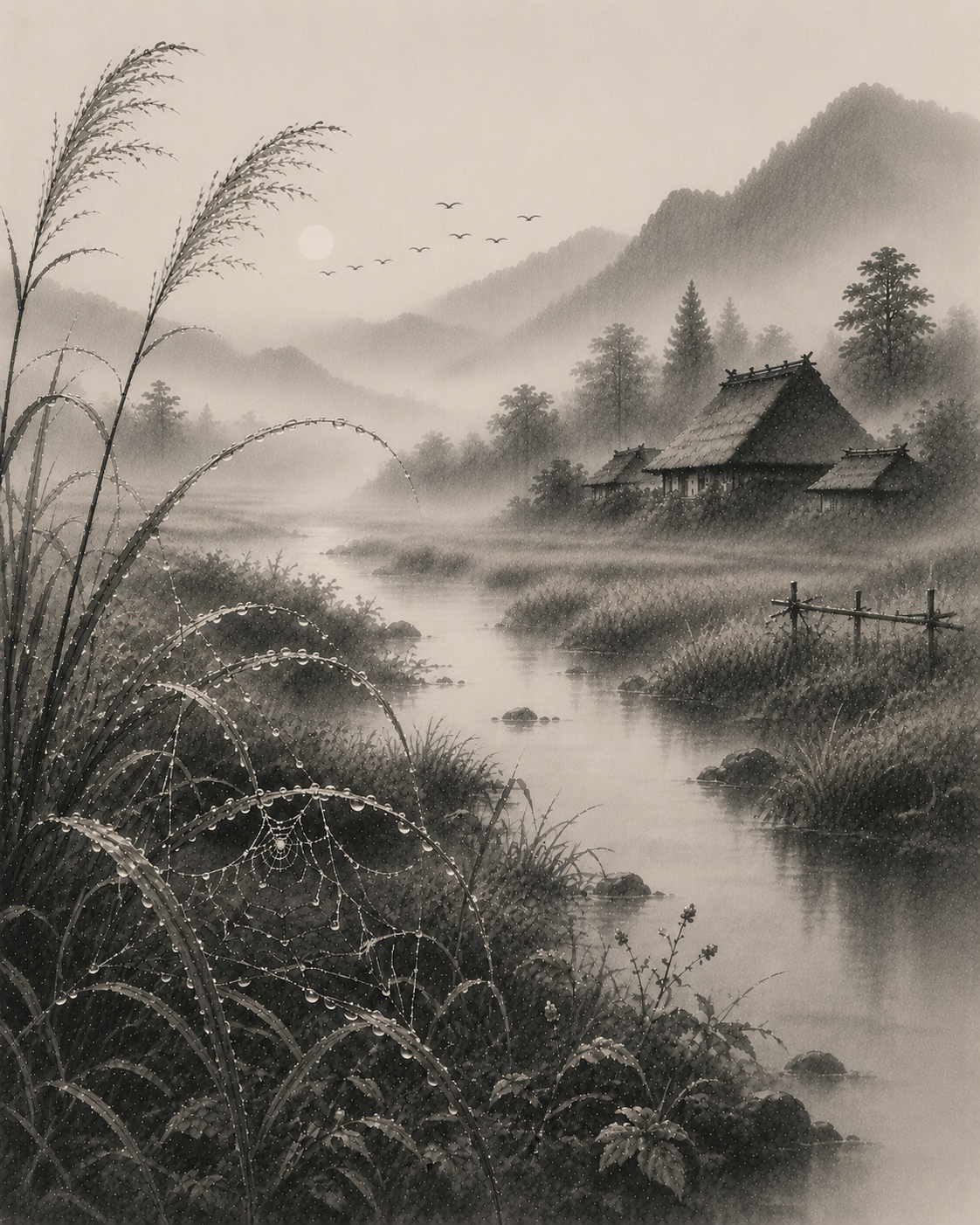
Dew Forms on Grass
Masaru-sensei rose before sunrise.
The valley remained quiet beneath a pale layer of mist.
He followed a narrow path beside the river and soon found Sayo gathering herbs in a basket woven from bamboo.
The herbalist moved slowly.
Not because she was tired.
Because she was looking carefully.
A patch of grass beside the path caught the first light of morning.
Thousands of dew droplets sparkled like scattered pearls.
Nearby, a spider web stretched between two stems.
Every strand had become visible.
The web had been there yesterday.
No one had noticed it.
The dew had revealed what was already present.
Sayo smiled.
"The world becomes generous when we slow down."
Masaru-sensei stood quietly.
The web seemed more beautiful than many flowers.
Not because it had changed.
Because he had.
That afternoon he arranged dew-covered grass beside a small branch supporting a web.
The arrangement appeared delicate.
Almost temporary.
Visitors leaned closer than usual.
The details required attention.
So did the season.
Character Spotlight
Sayo observes nature with extraordinary patience. She believes most people miss beauty because they move too quickly.
Ikebana Reflection
Materials
Dew Covered Grass, Spider Web
Theme
Attention
Lesson
The smallest details often reveal the greatest beauty.
Ko 44
Wagtails Sing
Aki heard the bird before she saw it.
The wagtail darted along the riverbank, stopping only long enough to wag its tail before racing forward again.
Masaru-sensei watched her chase it from stone to stone.
The bird never stayed still.
Neither did Aki.
Each time the wagtail disappeared behind reeds, the girl hurried after it.
Each time she thought she had lost it, the bird reappeared somewhere else.
By midday she finally stopped beside a large rock and laughed.
"I don't think it wants to be caught."
Masaru-sensei smiled.
"Perhaps it only wants to be followed."
The answer pleased her.
For the rest of the afternoon she watched rather than chased.
The experience changed.
The bird seemed happier.
So did she.
That evening Masaru-sensei arranged river grass and a small feather found beside the stream.
The arrangement carried movement despite remaining still.
Visitors often smiled when they saw it.
The reason was difficult to explain.
Some things simply carried joy.
Like wagtails.
Like children.
Like autumn mornings beside the river.
Character Spotlight
Aki approaches life as though every day contains a hidden story. Her enthusiasm often helps others notice what they would otherwise overlook.
Ikebana Reflection
Materials
River Grass, Wagtail Feather
Theme
Joy
Lesson
Happiness often arrives unexpectedly.
Ko 45
Swallows Depart
The sky felt larger than usual.
Masaru-sensei noticed it while crossing the bridge.
The swallows were gone.
Not all at once.
Not dramatically.
Simply fewer each day until one morning the air above the village seemed empty.
Ren stood beside the river watching the northern sky.
"You always notice when they arrive," Masaru-sensei said.
The scholar nodded.
"I notice when they leave too."
Together they watched the clouds drift across the valley.
The silence felt different.
Not unpleasant.
Just unfamiliar.
For months the swallows had woven themselves into daily life.
Now their absence had become part of the season.
Ren smiled.
"Leaving doesn't mean something wasn't important."
Masaru-sensei considered the words.
The birds belonged to the village.
Even while they were gone.
That afternoon he arranged autumn grass beside a bare branch.
The empty branch created more emotion than any flower.
Visitors often asked what was missing.
Masaru-sensei answered carefully.
"Nothing."
The arrangement was about departure.
And departure is its own form of presence.
Character Spotlight
Ren understands migration better than most villagers. His travels have taught him that departures and returns are often part of the same journey.
Ikebana Reflection
Materials
Autumn Grass, Empty Branch
Theme
Farewell
Lesson
Letting go is part of belonging.
Ko Stories
Shubun – Autumn Equinox
Ko 46
Thunder Ceases
For months the valley had echoed with storms.
Thunder rolled across the mountains.
Summer rain drummed against roofs.
The sky often demanded attention.
Then one day it stopped.
No one noticed immediately.
The absence arrived gradually.
Masaru-sensei realized it while helping Sister Rei prepare the temple grounds for the equinox.
The morning felt unusually quiet.
Only the river could be heard.
And the wind.
Nothing else.
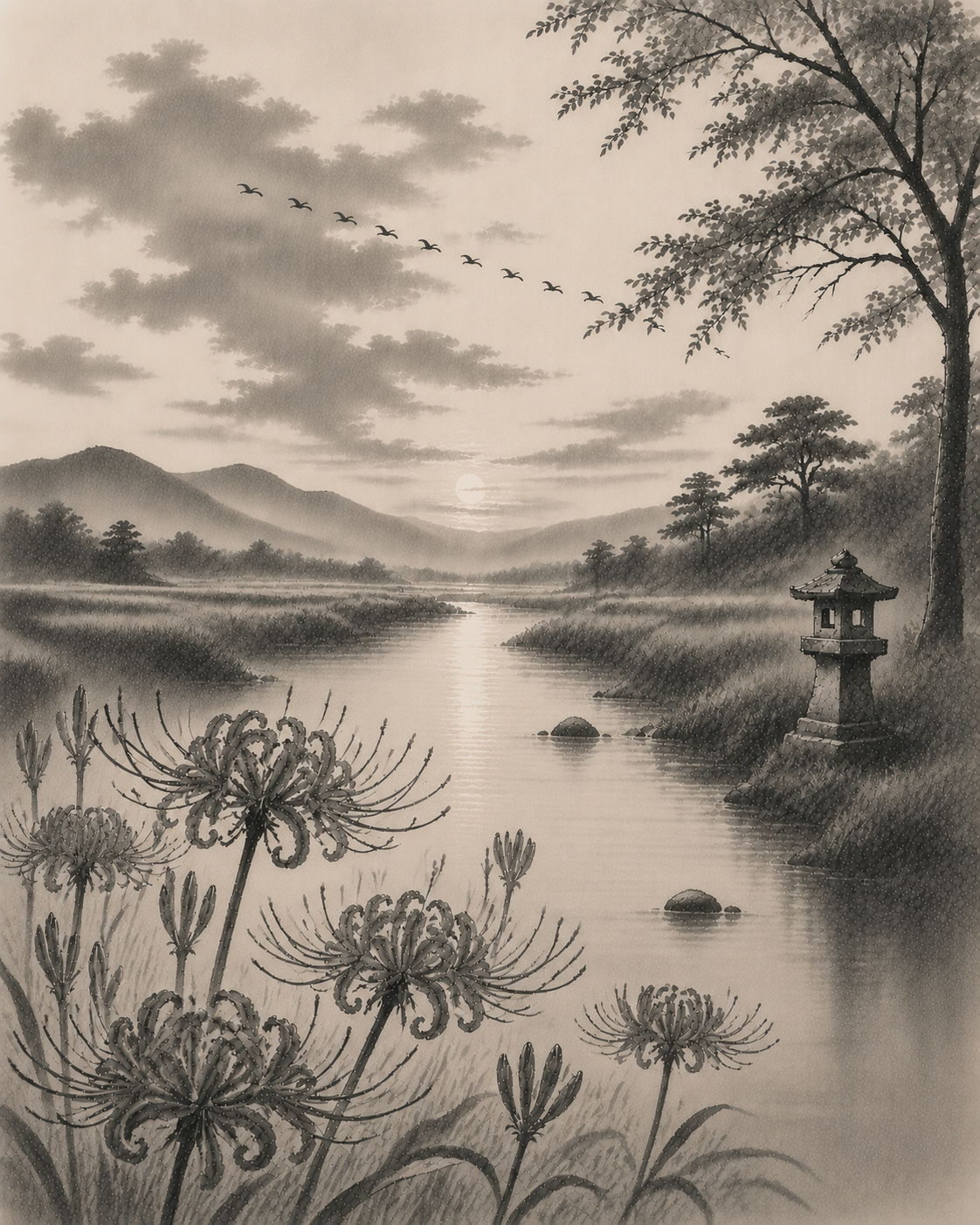
Near the temple path, higanbana had begun to bloom.
Their elegant forms seemed almost unreal against the fading grasses of autumn.
Sister Rei paused beside a cluster.
"People often think peace is something new."
Masaru-sensei looked toward the mountains.
"What is it then?"
"The space left behind when noise departs."
That afternoon he arranged higanbana with river reeds.
The composition felt spacious.
Breathing.
Visitors stood before it longer than usual.
The arrangement did not demand attention.
It invited it.
Like the season.
Character Spotlight
Sister Rei understands the rhythm of stillness. She believes every season teaches something different about paying attention.
Ikebana Reflection
Materials
Higanbana, River Reed
Theme
Balance
Lesson
Silence is easier to hear after noise.
Ko 47
Insects Hide Underground
Haru noticed it first.
The fields had become quieter.
Not silent.
Just quieter.
The buzzing insects that filled summer afternoons were disappearing one by one.
Masaru-sensei joined the boy beside a field near the river.
Together they listened.
A few crickets remained.
A few grasshoppers still moved among the reeds.
But something had changed.
The world seemed to be folding inward.
"Where do they go?" Haru asked.
"Beneath the soil."
"Why?"
Masaru-sensei thought for a moment.
"To survive."
The answer satisfied neither of them completely.
Yet both understood it.
Not every season is meant for activity.
Not every season is meant for growth.
That afternoon Masaru-sensei arranged higanbana beside several stems of dry grass.
The flowers appeared energetic.
The grasses appeared tired.
Together they told the truth.
Rest is not failure.
It is preparation.
Character Spotlight
Haru has begun noticing not only what appears, but what disappears. This makes him one of the village's most perceptive observers of seasonal change.
Ikebana Reflection
Materials
Higanbana, Dry Grass
Theme
Rest
Lesson
Withdrawal is not the same as absence.
Ko 48
Rice Fields Drained
The water had left the paddies.
For months the terraces reflected clouds, mountains, and sky.
Now they reflected memory.
Harvest season had arrived.
Families moved through the fields gathering grain.
Others walked toward the cemetery beyond the river.
The autumn equinox was a time for remembering.
Masaru-sensei found Hana carrying flowers toward her husband's grave.
The old woman moved slowly but confidently.
The path was familiar.
She had walked it many times.
They stood together for a while among the stones.
The valley stretched below them.
Golden fields.
Distant rooftops.
The winding river.
Life continuing.
"People think remembrance is about the past," Hana said.
Masaru-sensei listened.
"It is also about gratitude."
That afternoon he arranged higanbana beside a harvested rice stalk.
The composition felt complete.
Not because it celebrated an ending.
Because it acknowledged a journey.
Visitors often became quiet while viewing it.
Masaru-sensei understood why.
The arrangement asked them to remember.
Character Spotlight
Hana has become one of the emotional anchors of Yuki no Sato. Her understanding of loss, gratitude, and continuity helps others navigate the changing seasons of their own lives.
Ikebana Reflection
Materials
Higanbana, Rice Stalk
Theme
Remembrance
Lesson
Gratitude connects the past and present.
Ko Stories
Kanro – Cold Dew
Ko 49
Wild Geese Return
The first geese appeared just after sunrise.
Nobu noticed them before anyone else.
The retired teacher stood beside the river with his hands folded behind his back, watching the sky.
Masaru-sensei followed his gaze.
A long V-shaped formation crossed above the valley.
The birds moved steadily southward.
Not hurried.
Not delayed.
Simply following their season.
Nobu smiled.
"When I was young, I thought they were choosing where to go."
"And now?"
"I think they are remembering."
The answer lingered in Masaru-sensei's mind.
The geese did not seem uncertain.
They belonged to the sky as naturally as fish belonged to water.
That afternoon Masaru-sensei arranged a chrysanthemum with several stems of autumn grass.
The grasses leaned toward open space.
The flower remained steady.
Movement and stability.
Journey and home.
Visitors often admired the chrysanthemum.
Nobu admired the direction.
Character Spotlight
Nobu spent decades teaching children to read and write. In retirement he studies the sky, believing that birds teach many of the same lessons as books.
Ikebana Reflection
Materials
Chrysanthemum, Autumn Grass
Theme
Perspective
Lesson
Distance helps reveal patterns.
Ko 50
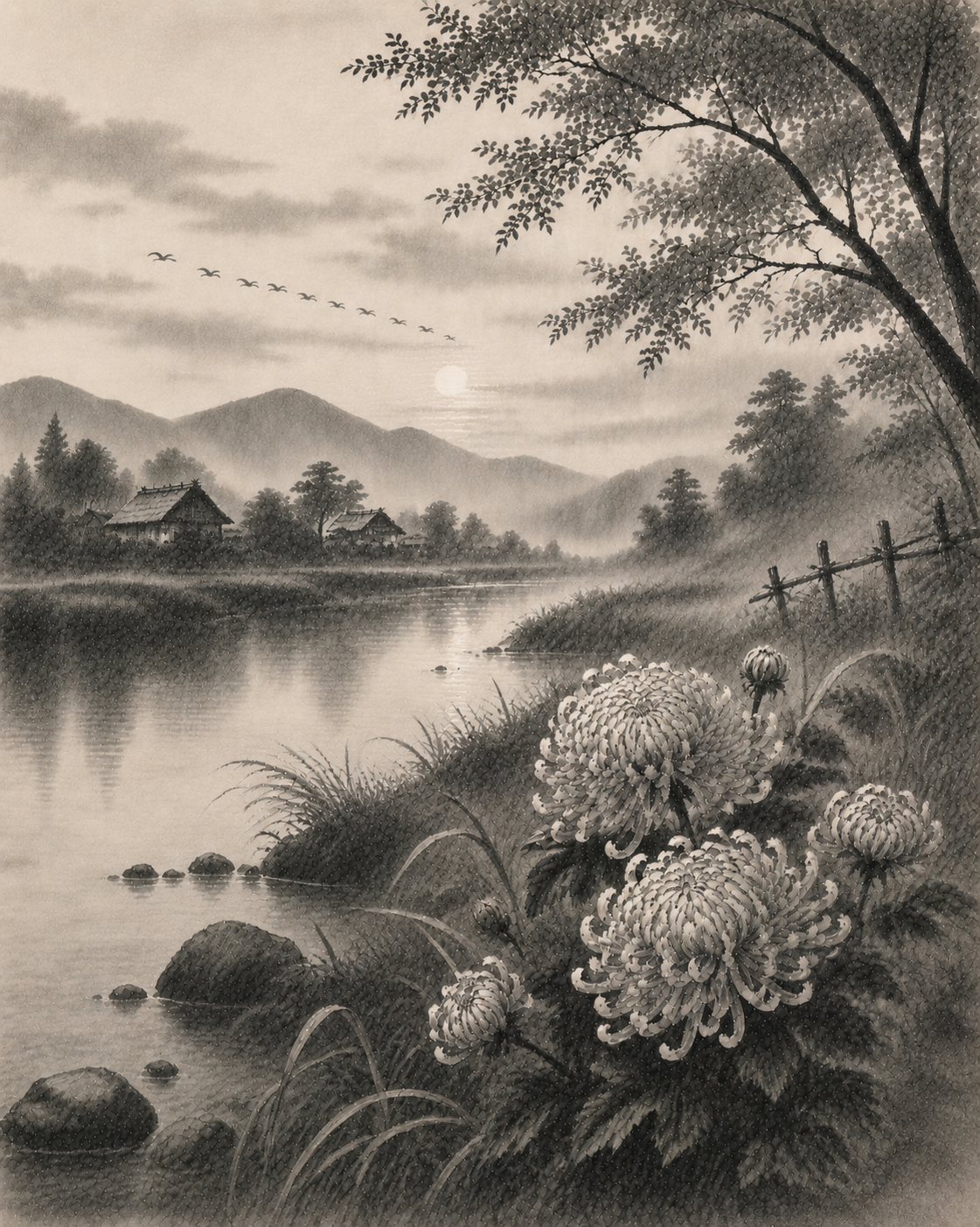
Chrysanthemums Bloom
The temple garden reached its quiet peak in mid-autumn.
While spring flowers competed for attention and summer blossoms seemed eager to impress, chrysanthemums carried themselves differently.
They waited.
Sister Rei knelt among the flowers, removing damaged leaves and spent blooms.
The work was meticulous.
Masaru-sensei watched for a while before asking a question.
"Why spend so much time on details no one will notice?"
Sister Rei held up a flower.
"Someone notices."
"The visitors?"
She smiled.
"The flower."
The answer made him laugh.
Yet he understood.
The chrysanthemum seemed complete.
Not flashy.
Not dramatic.
Simply confident.
That afternoon Masaru-sensei arranged a single chrysanthemum beside a simple branch.
Nothing else.
The arrangement felt mature.
Like the season itself.
Visitors often called it elegant.
Sister Rei preferred another word.
Enough.
Character Spotlight
Sister Rei sees maintenance as a form of respect. Whether caring for gardens, buildings, or people, she believes attention is an expression of gratitude.
Ikebana Reflection
Materials
Chrysanthemum, Simple Branch
Theme
Refinement
Lesson
Beauty deepens when distractions fall away.
Ko 51
Crickets Chirp Near the Door
The evenings had become colder.
Lantern light appeared earlier each day.
Mei worked late in her workshop, finishing lanterns for an upcoming festival.
Outside, crickets chirped near the doorway.
The sound accompanied her work like a familiar song.
Most people barely noticed them.
Mei did.
The insects had become part of the season's rhythm.
One evening Masaru-sensei stopped by with tea.
Neither spoke much.
The crickets filled the silence comfortably.
After a while Mei laughed.
"They're better conversationalists than some villagers."
Masaru-sensei could not disagree.
The sound seemed to belong exactly where it was.
Neither demanding attention nor disappearing entirely.
Present.
Reliable.
That afternoon he arranged a chrysanthemum beside a dark autumn leaf.
The flower carried light.
The leaf carried shadow.
The space between them felt alive.
Like the pauses between cricket songs.
Like friendship.
Character Spotlight
Mei creates lanterns that illuminate homes and celebrations throughout Yuki no Sato. She values quiet company and believes comfort often arrives in subtle forms.
Ikebana Reflection
Materials
Chrysanthemum, Dark Leaf
Theme
Companionship
Lesson
Small presences often matter most.
Ko Stories
Soko – Frost Descent
Ko 52
First Frost Appears
The frost arrived quietly.
Most villagers did not notice it until sunlight touched the fields.
Tiny crystals covered the grass beside the river.
The rooftops shimmered silver.
Masaru-sensei found Gen walking through his persimmon orchard before sunrise.
The orchard keeper stopped beside a tree heavy with fruit.
He brushed frost from one of the persimmons.
"It has begun."
Masaru-sensei looked around.
The valley still seemed peaceful.
The leaves remained on many trees.
The river continued its slow journey toward the sea.
Yet the frost changed everything.
Winter had sent its first message.
Gen did not seem disappointed.
Instead, he looked relieved.
The fruit was ready.
The harvest was near.
The season had arrived exactly as it should.
That afternoon Masaru-sensei arranged a persimmon branch with frost-touched grass.
The fruit carried warmth.
The frost carried warning.
Together they created balance.
Neither could exist without the other.
Character Spotlight
Gen has tended the village orchard for more than thirty years. He trusts seasonal timing completely and rarely worries about things beyond his control.
Ikebana Reflection
Materials
Persimmon Branch, Frost Touched Grass
Theme
Acceptance
Lesson
Change becomes easier when it is expected.
Ko 53
Light Rains Fall
A gentle rain settled over Yuki no Sato.
Not enough to keep people indoors.
Not enough to flood the paths.
Just enough to remind everyone that autumn was nearing its end.
Masaru-sensei found Gen repairing a fence around the orchard.
Rainwater dripped from his hat.
Mud clung to his boots.
Yet he continued working without complaint.
"You could wait until tomorrow."
Gen smiled.
"The fence cannot."
The answer seemed obvious once spoken.
The orchard did not care about convenience.
Trees required pruning.
Fences required repair.
Fruit required gathering.
The season continued whether people felt motivated or not.
The rain fell steadily all afternoon.
By evening the repaired section of fence stood strong and straight.
Masaru-sensei returned home carrying a persimmon leaf darkened by rain.
He arranged it beside a bare branch gathered from the orchard.
The composition seemed modest.
Visitors often overlooked it.
Gen would have appreciated that.
Much of his work was the same.
Quiet.
Necessary.
Lasting.
Character Spotlight
Gen values consistency over intensity. He believes most worthwhile accomplishments result from steady work performed over long periods of time.
Ikebana Reflection
Materials
Persimmon Leaf, Bare Branch
Theme
Persistence
Lesson
Small efforts accumulate just as surely as rain.
Ko 54
Maple and Ivy Turn Color
The hills above the village had become a tapestry.
Every path revealed new patterns of color.
Maples glowed against dark pines.
Ivy climbed stone walls in winding ribbons.
Even familiar places seemed transformed.
Masaru-sensei met Chiyo on a hillside overlooking the valley.
The peony grower carried a basket but had stopped gathering materials.
Instead she simply looked.
The two stood together in comfortable silence.
Finally Chiyo spoke.
"People always talk about spring."
Masaru-sensei smiled.
"And autumn?"
She gestured toward the mountains.
"I think autumn is nature showing us what completion looks like."
The words stayed with him.
Spring promised.
Summer expanded.
Autumn fulfilled.
That afternoon Masaru-sensei arranged a persimmon branch with a twisting autumn vine.
The composition felt complete.
Not because everything had ended.
Because everything had become what it was meant to become.
The season carried a quiet confidence.
So did the arrangement.
Character Spotlight
Chiyo understands cycles better than most villagers. Years spent cultivating peonies have taught her that every season has its own form of perfection.
Ikebana Reflection
Materials
Persimmon Branch, Autumn Vine
Theme
Completion
Lesson
Some of nature's greatest beauty appears just before rest.
Ko Stories
Ritto – Beginning of Winter
Ko 55
Camellias Begin to Bloom
Winter announced itself without snow.
The leaves had mostly fallen.
The fields had emptied.
The river seemed quieter than before.
Masaru-sensei met Goro near the edge of the forest where the woodcutter spent most mornings gathering fuel for the village.
The trees stood bare against the gray sky.
Yet beside the path a camellia had opened.
Its petals appeared almost defiant.
Goro stopped and smiled.
"Most flowers choose easier seasons."
Masaru-sensei touched one of the blossoms.
The flower seemed unconcerned with comfort.
It bloomed because it was time.
Not because conditions were favorable.
The lesson felt familiar.
Many villagers postponed important things until circumstances improved.
Nature rarely waited.
That afternoon Masaru-sensei arranged camellia beside a weathered branch from the forest.
The branch carried the memory of hardship.
The flower carried the courage to continue.
Visitors often called the arrangement hopeful.
Goro called it practical.
Character Spotlight
Goro has spent his life in the forests surrounding Yuki no Sato. He respects resilience wherever he finds it, whether in people, trees, or flowers.
Ikebana Reflection
Materials
Camellia, Bare Branch
Theme
Endurance
Lesson
Beauty does not wait for ideal conditions.
Ko 56
Ground Begins to Freeze
The first frozen puddle appeared beside the road leading out of the village.
Toma discovered it before sunrise.
By the time Masaru-sensei arrived, the young man had already broken the thin ice several times with a stick.
"It keeps coming back."
Masaru-sensei laughed.
"So does winter."
Toma stared toward the distant mountain pass.
He still dreamed of leaving Yuki no Sato.
Yet each season seemed to delay his departure.
The frozen puddle reflected his frustration.
The road existed.
The destination existed.
But conditions were not yet right.
The young man kicked a stone into the frost.
"I feel stuck."
Masaru-sensei pointed toward the hills.
"The mountains aren't going anywhere."
The answer annoyed Toma at first.
Later it comforted him.
That afternoon Masaru-sensei arranged frosted grass with a bare branch.
The arrangement felt still.
Not stagnant.
Simply waiting.
Like winter.
Like Toma.
Like many worthwhile things.
Character Spotlight
Toma dreams of distant places, but he is gradually learning that preparation is part of every successful departure.
Ikebana Reflection
Materials
Bare Branch, Frosted Grass
Theme
Patience
Lesson
Not every journey requires immediate movement.
Ko 57
Narcissus Leaves Emerge
The garden looked asleep.
Most plants had retreated beneath the soil.
The trees stood bare.
The mornings carried frost.
Yet Hana's garden held a secret.
Near the edge of the stone path, several slender green leaves pushed through the cold earth.
Narcissus.
Masaru-sensei noticed them while helping Hana stack firewood.
The leaves were easy to miss.
Most visitors walked past them without a glance.
Hana never did.
"They always arrive when people need them."
Masaru-sensei smiled.
"Flowers?"
"No. Hope."
The answer felt exactly right.
The leaves promised blossoms months before any would appear.
Winter had only begun.
Yet spring had already left a message.
That afternoon Masaru-sensei arranged narcissus leaves beside a camellia blossom.
The composition joined present beauty with future beauty.
Visitors often focused on the flower.
Hana focused on the leaves.
She understood that promises deserve attention too.
Character Spotlight
Hana's wisdom comes from experience rather than study. She notices small signs of hope because she has lived through many winters.
Ikebana Reflection
Materials
Narcissus Leaves, Camellia
Theme
Hope
Lesson
Renewal often begins when conditions seem least favorable.
Ko Stories
Shosetsu – Lesser Snow
Ko 58
Rain Turns to Snow
Rin had never watched snow arrive.
She had seen snow before.
Everyone in Yuki no Sato had.
But she had never witnessed the moment rain became snow.
Masaru-sensei found her standing beside the stream, staring at the sky.
Drops of rain fell steadily around them.
Then one landed on her sleeve.
Not a drop.
A snowflake.
The next one followed.
Then another.
The river remained dark.
The fields remained brown.
Yet the season had changed.
Rin stretched out both hands.
For nearly an hour she watched the flakes drift from the clouds.
Most melted immediately.
A few survived.
The child laughed every time one landed successfully.
That afternoon Masaru-sensei arranged dried grass with several snow berries gathered near the edge of the field.
The arrangement felt quiet.
Like the first snow itself.
Not enough to transform the landscape.
Just enough to announce what was coming.
Character Spotlight
Rin is Mika's daughter and one of the youngest recurring characters in Yuki no Sato. She experiences each season with complete sincerity and curiosity.
Ikebana Reflection
Materials
Dried Grass, Snow Berry
Theme
Wonder
Lesson
Familiar things can become extraordinary overnight.
Ko 59
North Wind Blows Leaves Away
The storm passed during the night.
By morning the trees stood nearly bare.
Leaves that had clung stubbornly to branches for weeks now covered the ground.
Masaru-sensei met Goro along a path beside the field.
The woodcutter carried an armful of firewood.
The wind followed close behind.
A final leaf spiraled from a nearby tree and landed at their feet.
Goro watched it settle.
"Now we can see the tree."
Masaru-sensei looked upward.
The branches stretched against the pale sky.
Every line visible.
Every shape revealed.
The leaves had been beautiful.
Yet their absence revealed something beautiful too.
Structure.
Form.
Essence.
That afternoon Masaru-sensei arranged a single fallen leaf beside a bare branch.
The arrangement felt unusually sparse.
Visitors often assumed something was missing.
Goro disagreed.
The arrangement contained exactly what it needed.
Nothing more.
Character Spotlight
Goro appreciates directness. Years spent working in the forest have taught him that clarity often appears when unnecessary things fall away.
Ikebana Reflection
Materials
Bare Branch, Fallen Leaf
Theme
Simplicity
Lesson
Sometimes less reveals more.
Ko 60
Citrus Turns Yellow
The days had become noticeably shorter.
Lanterns were lit earlier.
The river reflected more shadow than light.
Yet Aya's house felt brighter than ever.
Masaru-sensei arrived to find baskets of citrus fruit stacked near the hearth.
Their color seemed to carry sunlight into the room.
Aya handed him one.
The fragrance immediately filled the air.
Outside, the world had become muted.
Inside, the fruit glowed.
"The season provides what we need."
Aya smiled as she sorted the harvest.
Winter demanded warmth.
The citrus answered.
The balance felt natural.
That afternoon Masaru-sensei arranged a small citrus branch beside an evergreen cutting.
The composition felt cheerful despite its simplicity.
Visitors often smiled without understanding why.
The answer was easy.
The arrangement carried light into a darker season.
Just as Aya's kitchen did.
Character Spotlight
Aya has spent a lifetime preserving food, stories, and traditions. She believes every season offers exactly what people need, though sometimes they must look carefully to find it.
Ikebana Reflection
Materials
Citrus Branch, Evergreen
Theme
Warmth
Lesson
Brightness becomes more meaningful during dark seasons.
Ko Stories
Taisetsu – Greater Snow
Ko 61
The Sky Grows Cold
The snow field beyond the village seemed endless.
Masaru-sensei followed the path that wound past the old tree and climbed toward the open valley.
The air felt sharper than it had only days before.
The sky itself seemed colder.
Ahead of him, Isao worked alone.
The path keeper carried a wooden shovel and cleared snow from the narrow trail connecting several homes.
No one had asked him to do it.
No one expected praise.
Yet every traveler would benefit from his effort.
Masaru-sensei stopped beside him.
"The storm ended yesterday."
Isao nodded.
"The path remains today."
The answer explained everything.
Some work begins after difficulty ends.
Together they looked across the snow-covered field.
The world appeared still.
Yet beneath that stillness the village continued functioning because people like Isao quietly carried responsibility.
That afternoon Masaru-sensei arranged snow-covered grass with a winter reed.
The arrangement felt simple.
Steady.
Reliable.
Like the path itself.
Character Spotlight
Isao maintains paths, bridges, and roads throughout Yuki no Sato. He believes the most important work is often the work that prevents problems from occurring.
Ikebana Reflection
Materials
Snow Covered Grass, Winter Reed
Theme
Responsibility
Lesson
The work that supports others is often done quietly.
Ko 62
Bears Begin to Hibernate
The forest felt different.
Quieter.
The signs were subtle.
Tracks disappeared from familiar paths.
Birdsong became less frequent.
Even the mountain streams seemed softer beneath their blankets of snow.
Masaru-sensei joined Goro on a winter walk through the forest.
The woodcutter pointed toward a rocky hillside.
"The bears have settled in."
Masaru-sensei imagined the animals resting deep within hidden dens.
The idea felt strange.
The village worked constantly.
The forest knew another rhythm.
Goro stopped beside a snow-covered pine.
"People think rest means doing nothing."
He brushed snow from a branch.
"The forest disagrees."
The trees rested.
The animals rested.
The earth rested.
Yet life continued.
Preparation happened in silence.
That afternoon Masaru-sensei arranged a pine branch beside a snow-covered twig.
The arrangement carried very little movement.
Very little energy.
And yet it felt alive.
Like winter itself.
Character Spotlight
Goro spends enough time in the forest to understand its slower rhythms. He respects rest as much as labor.
Ikebana Reflection
Materials
Pine Branch, Snow Covered Twig
Theme
Rest
Lesson
Recovery is productive.
Ko 63
Salmon Gather
The river looked colder than ever.
Ice formed along the edges.
Mist drifted above the water each morning.
Yet beneath the surface, movement continued.
Jiro stood beside the river before sunrise watching salmon push upstream.
The fish moved against the current.
Every bend seemed to resist them.
Every obstacle demanded effort.
Still they continued.
Masaru-sensei watched quietly.
The salmon appeared exhausted.
Determined.
Purposeful.
Jiro nodded toward the water.
"They know where they belong."
The fisherman admired that certainty.
Most people spent years searching for direction.
The salmon never seemed confused.
The journey was difficult.
Yet the destination remained clear.
That afternoon Masaru-sensei arranged pine beside a curved river branch.
The branch guided the eye upward through the composition.
Against resistance.
Against gravity.
Against expectation.
Like the salmon.
Visitors often described the arrangement as strong.
Jiro preferred another word.
Committed.
Character Spotlight
Jiro has spent a lifetime observing rivers and migrations. He believes purpose becomes visible when conditions are hardest.
Ikebana Reflection
Materials
Pine, Curved River Branch
Theme
Perseverance
Lesson
Meaningful journeys are often difficult.
Ko Stories
Toji – Winter Solstice
Ko 64
Self-Heal Sprouts
The longest night of the year had arrived.
Snow covered the garden outside Aya's home, and the only light came from the warm glow of a single window.
Masaru-sensei stopped by after sunset.
Inside, the room smelled of tea and citrus.
Aya was preparing a simple meal while snow drifted quietly beyond the paper screens.
Near the doorway, a shallow tray held several tiny green shoots.
Masaru-sensei knelt beside them.
"They survived?"
Aya smiled.
"They started."
The distinction mattered.
Most people looked at winter and saw endings.
Aya saw beginnings.
The sprouts were barely visible.
Yet they carried more promise than many summer flowers.
Outside, darkness ruled the valley.
Inside, life had already started preparing for spring.
That evening Masaru-sensei arranged pine beside a single green sprout.
The pine represented endurance.
The sprout represented possibility.
Together they carried the meaning of the solstice.
The longest night.
And the return of light.
Character Spotlight
Aya has lived through many winters and trusts the cycle completely. She pays close attention to small beginnings because she knows how powerful they become.
Ikebana Reflection
Materials
Pine, Green Sprout
Theme
Renewal
Lesson
Hope often begins invisibly.
Ko 65
Deer Shed Antlers
Several days after the solstice, Isao discovered a deer antler near the forest edge.
The antler lay half-buried in snow.
Perfectly intact.
Masaru-sensei turned it over in his hands.
"It seems strange."
"What does?"
"Something so strong being left behind."
Isao nodded.
"The deer would disagree."
The hunter explained that antlers are not lost through weakness.
They are released because new growth will come.
The old must make room for the new.
Masaru-sensei carried that lesson with him throughout the day.
People often cling to things long after they have served their purpose.
The deer did not.
Nature rarely did.
That evening he arranged pine beside the antler.
The pine represented continuity.
The antler represented release.
Visitors found the arrangement unusual.
Isao found it truthful.
Character Spotlight
Isao understands that survival depends on adaptation. Years in the mountains have taught him that nature renews itself through continual change.
Ikebana Reflection
Materials
Pine Branch, Curved Antler
Theme
Release
Lesson
Growth sometimes requires letting go.
Ko 66
Wheat Sprouts Under Snow
Snow covered every field in Yuki no Sato.
The terraces appeared asleep.
The roads appeared empty.
The valley seemed frozen in place.
Yet Mika knew better.
While preparing dinner one evening, she told Masaru-sensei about the wheat beneath the snow.
"You cannot see it."
"But it is there."
The statement reminded him of many things.
Trust.
Family.
The future.
Not every important thing announces itself.
Some continue quietly beneath the surface.
After the meal, Mika's daughter Rin pressed her face against the window and watched snowflakes drift through the lantern light.
The child saw winter.
Mika saw spring hidden inside it.
That evening Masaru-sensei arranged pine beside a single wheat shoot.
The shoot seemed fragile.
Almost insignificant.
Yet it carried the entire future harvest within it.
Visitors often overlooked the wheat.
Mika never did.
Character Spotlight
Mika understands long-term care better than most villagers. Raising a family has taught her that growth often happens slowly and invisibly.
Ikebana Reflection
Materials
Pine, Wheat Shoot
Theme
Faith
Lesson
Life continues even when we cannot see it.
Ko Stories
Shokan – Lesser Cold
Ko 67
Parsley Flourishes
The garden behind Masaru-sensei's house seemed frozen.
Snow covered the stepping stones.
The pond sat silent beneath a thin layer of ice.
Even the pine wore a coat of snow.
Yet near the edge of a stone lantern, Sayo discovered a patch of green.
Parsley.
The herb had survived the cold.
Masaru-sensei knelt beside it in surprise.
Most plants had retreated underground.
This one remained.
The leaves were not dramatic.
Not beautiful in the way flowers are beautiful.
Yet they felt stubbornly alive.
Sayo smiled.
"Some things are strongest because they remain small."
The answer reminded Masaru-sensei of several villagers.
People who quietly continued their work while others received attention.
That evening he arranged a snow-covered pine branch beside the winter herb.
The pine dominated the composition.
The parsley nearly disappeared.
Yet visitors who noticed the herb understood the arrangement immediately.
The smallest element carried the lesson.
Character Spotlight
Sayo has spent decades studying plants. She trusts small signs more than dramatic ones because nature often speaks quietly.
Ikebana Reflection
Materials
Pine, Winter Herb
Theme
Resilience
Lesson
Small things often endure where larger things cannot.
Ko 68
Springs Begin to Stir
The garden appeared frozen.
The pond remained still.
The paths remained covered with snow.
Yet the bamboo water basin continued its slow rhythm.
Drip.
Pause.
Drip.
Pause.
Masaru-sensei found Saburo repairing the bamboo spout early one morning.
The craftsman removed a section worn by years of flowing water.
"Most people think winter stops everything."
He held the old bamboo up to the light.
"The water disagrees."
The basin overflowed gently into the snow.
The sound was small.
Easy to overlook.
Yet it transformed the entire garden.
Without it, the winter silence would have felt empty.
With it, the silence felt alive.
That afternoon Masaru-sensei arranged pine beside a reed gathered near the basin.
The composition carried very little movement.
Yet viewers often sensed motion within it.
Saburo appreciated that.
The most important movement is often the movement people cannot immediately see.
Character Spotlight
Saburo notices systems more than objects. He pays attention to how things work together and often discovers problems before they become visible.
Ikebana Reflection
Materials
Pine, Water Basin Reed
Theme
Persistence
Lesson
Movement continues even when hidden.
Ko 69
Pheasants Begin to Call
The morning was colder than usual.
Masaru-sensei crossed the snowy garden before sunrise and found Taku sitting beneath the pine tree.
The old man was listening.
To what, Masaru-sensei wasn't sure.
Then it came.
A distant pheasant call echoed from the hillside.
The sound crossed the valley and disappeared.
Several minutes later it came again.
The call seemed lonely.
Yet it carried certainty.
The bird was announcing itself to the world.
Taku smiled.
"Most people spend their lives waiting to be heard."
Masaru-sensei looked toward the mountains.
"The pheasant doesn't seem worried about that."
The elder laughed.
"It speaks because it has something to say."
The lesson stayed with him.
That afternoon Masaru-sensei arranged pine with winter grass gathered from the hillside.
The arrangement felt quiet.
Restrained.
Visitors often stood silently before it.
The silence became part of the experience.
Just as it had been part of the morning.
Character Spotlight
Taku believes wisdom begins with listening. Age has taught him that understanding often comes after observation rather than before it.
Ikebana Reflection
Materials
Pine, Winter Grass
Theme
Listening
Lesson
Important messages often arrive quietly.
Ko Stories
Daikan – Greater Cold
Ko 70
Butterbur Buds Appear
The cold had settled deeply into Yuki no Sato.
Snow lingered in shaded places.
The river moved slowly beneath thin sheets of ice.
Even the pine in Masaru-sensei's garden seemed to hold its breath.
While clearing a path after a light snowfall, he noticed something unusual beside a stone.
A small green bud pushed through the frozen ground.
Butterbur.
It seemed impossible.
The mountains remained locked in winter.
The fields slept beneath snow.
Yet here was proof that spring had already begun preparing its return.
Masaru-sensei knelt beside the bud for a long time.
No flowers.
No leaves.
Only possibility.
That afternoon he arranged a pine branch beside the tiny bud.
The pine represented endurance.
The butterbur represented emergence.
Visitors often focused on the pine.
Masaru-sensei understood.
The bud was easy to miss.
Spring usually is.
Character Spotlight
Masaru-sensei has spent the year observing the seasons and the villagers of Yuki no Sato. The more he learns, the more he realizes nature rarely announces its greatest changes loudly.
Ikebana Reflection
Materials
Pine, Butterbur Bud
Theme
Beginnings
Lesson
Renewal often begins beneath our notice.
Ko 71
Streams Freeze Deeply
The coldest morning of the year arrived without warning.
The basin in Masaru-sensei's garden stood rimmed with ice.
The stream beyond the house had nearly disappeared beneath a frozen surface.
Saburo stopped by carrying a replacement bamboo spout.
Together they examined the garden.
Everything appeared motionless.
Frozen.
Silent.
Yet beneath the ice, water still moved.
Slowly.
Patiently.
Relentlessly.
Saburo tapped the frozen basin.
"People trust what they can see too much."
Masaru-sensei laughed.
The craftsman was right.
Winter often disguises life.
The stream seemed asleep.
In reality it was preparing.
That afternoon Masaru-sensei arranged pine with several unopened plum buds.
The buds remained tightly closed.
Visitors questioned their inclusion.
"They are not blooming."
"No," Masaru-sensei replied.
"But they are becoming."
The distinction mattered.
Character Spotlight
Saburo sees movement inside stillness. Years spent working with natural materials have taught him that apparent inactivity often hides important change.
Ikebana Reflection
Materials
Pine, Plum Buds
Theme
Stillness
Lesson
Quiet does not mean lifeless.
Ko 72
Hens Begin Laying
A few days later, Rin arrived at Masaru-sensei's door carrying a basket.
Inside rested a single egg.
"The first one."
Masaru-sensei smiled.
The child held the basket carefully, as though carrying treasure.
In many ways she was.
The village remained cold.
Snow still covered the hills.
The pine in the garden still wore traces of winter.
Yet life had quietly begun returning.
The hens knew.
The butterbur knew.
The plum tree knew.
Rin led Masaru-sensei to the edge of the garden.
There, beside the snow-covered path, one plum blossom had opened.
Only one.
Small.
Fragile.
Perfect.
For a long time neither spoke.
Words seemed unnecessary.
That afternoon Masaru-sensei created the final arrangement of the year.
Pine.
Plum blossom.
Nothing more.
The pine carried winter.
The blossom carried spring.
Together they formed a bridge between endings and beginnings.
As evening settled over Yuki no Sato, Masaru-sensei looked toward the river.
Tomorrow he would visit Hana.
The camellias would not be far behind.
The year had ended.
The year had begun.
Character Spotlight
Rin has grown throughout the year from observer to participant. She reminds the village that wonder is not something we lose with age—it is something we choose to keep.
Ikebana Reflection
Materials
Pine, Plum Blossom
Theme
Renewal
Lesson
The cycle continues through ordinary moments.
Sekki 1
Risshun立春
Beginning of Spring
Around February 4-18
The first signs of spring stir beneath late winter air.
Theme
Awakening
Mood
Quiet upward movement with restrained brightness
Materials
Plum branches, camellia, early willow, evergreen accents
Spring begins in a single opening bud.
Ko 1
東風解凍Harukaze kori o tokuEast Wind Melts Ice
Feb 4-Feb 8
A five-day microseason: East Wind Melts Ice.
Ko 2
黄鶯睍睆Kou kenkan suBush Warbler Sings
Feb 9-Feb 13
A five-day microseason: Bush Warbler Sings.
Ko 3
魚上氷Uo kori o izuruFish Emerge From Ice
Feb 14-Feb 18
A five-day microseason: Fish Emerge From Ice.
Sekki 2
Usui雨水
Rain Water
Around February 19-March 4
Snow softens into rain, and frozen ground begins to loosen.
Theme
Thaw
Mood
Gentle release and fresh moisture
Materials
Pussy willow, narcissus, fern, pale blossoms
Rain writes the first soft line of spring.
Ko 4
土脉潤起Tsuchi no shou uruoi okoruRain Moistens The Soil
Feb 19-Feb 23
A five-day microseason: Rain Moistens The Soil.
Ko 5
霞始靆Kasumi hajimete tanabikuMist Starts To Linger
Feb 24-Feb 28
A five-day microseason: Mist Starts To Linger.
Ko 6
草木萌動Soumoku mebae izuruGrass And Trees Begin To Sprout
Mar 1-Mar 5
A five-day microseason: Grass And Trees Begin To Sprout.
Sekki 3
Keichitsu啓蟄
Awakening of Insects
Around March 5-19
Dormant life wakes as warmth gathers in the soil.
Theme
Emergence
Mood
Small motions breaking the surface
Materials
Forsythia, quince, budding branches, moss
Hidden life returns to the open air.
Ko 7
蟄虫啓戸Sugomori mushito o hirakuHibernating Insects Surface
Mar 5-Mar 9
A five-day microseason: Hibernating Insects Surface.
Ko 8
桃始笑Momo hajimete sakuPeach Blossoms
Mar 10-Mar 14
A five-day microseason: Peach Blossoms.
Ko 9
菜虫化蝶Namushi chou to naruCaterpillars Become Butterflies
Mar 15-Mar 19
A five-day microseason: Caterpillars Become Butterflies.
Sekki 4
Shunbun春分
Spring Equinox
Around March 20-April 3
Day and night balance while spring growth becomes visible.
Theme
Balance
Mood
Balanced lines with a clear point of bloom
Materials
Cherry branches, tulip, iris leaves, young greens
Light and shadow meet at spring’s center.
Ko 10
雀始巣Suzume hajimete sukauSparrows Start To Nest
Mar 20-Mar 24
A five-day microseason: Sparrows Start To Nest.
Ko 11
桜始開Sakura hajimete hirakuCherry Blossoms Open
Mar 25-Mar 29
A five-day microseason: Cherry Blossoms Open.
Ko 12
雷乃発声Kaminari sunawachi koe o hassuFirst Thunder Sounds
Mar 30-Apr 3
A five-day microseason: First Thunder Sounds.
Sekki 5
Seimei清明
Clear and Bright
Around April 4-19
Air clears, blossoms open, and the world feels freshly washed.